 Dypressuregauge
What Should My Pool Pressure Gauge Be At? (Ideal PSI)
Generally speaking, the pressure gauge of the pool pump mostly stays between 10 and 25 PSI. But to be honest, just looking at this approximate number is completely meaningless. The only way to find out what the pressure in your swimming pool should be is to record the “cleaning baseline” that belongs to your system immediately after installing a new filter element or after completely backwashing “. With this bottom in mind, you should be on guard as long as you find that the pressure gauge has soared by 8 to 10 PSI compared with this initial value.
Many swimming pool novices always blindly pursue the magic number of “15 PSI”, which is estimated from the old forum. If you cling to a fixed number, you will often end up 1 the green water in the pool, the burned water pump motor, and even the filter shell will crack directly.
The current pool plumbing system can be described as varied. A 3-horse high-power water pump connected to a rooftop solar heater may have a pressure of 25 PSI during normal operation. However, a small above-ground swimming pool can run very smoothly under 8 PSI. Therefore, you have to have your own method to find out the temper of your own equipment.
The B .O.T. Rule: Grab The True Filter Pressure
Stop guessing and take a test. Professional pool maintenance personnel will use the B .O.T. rule (I. e. baseline Baseline, operating fluctuation Operating, critical point Threshold) to determine the health of the filter.
Step 1: set your “clean baseline” (B)
The baseline is the PSI reading when the filter is 100% clean.
Clean the paper filter element, or thoroughly backwash the sand tank and diatomaceous earth (DE) filter. Then, turn the pump to the highest grade. Stare at the dial and see where the pointer points, and that number is your “clean baseline”. If the table shows 14 PSI, then your exclusive reference target in the future is 14 PSI, it’s as simple as that.
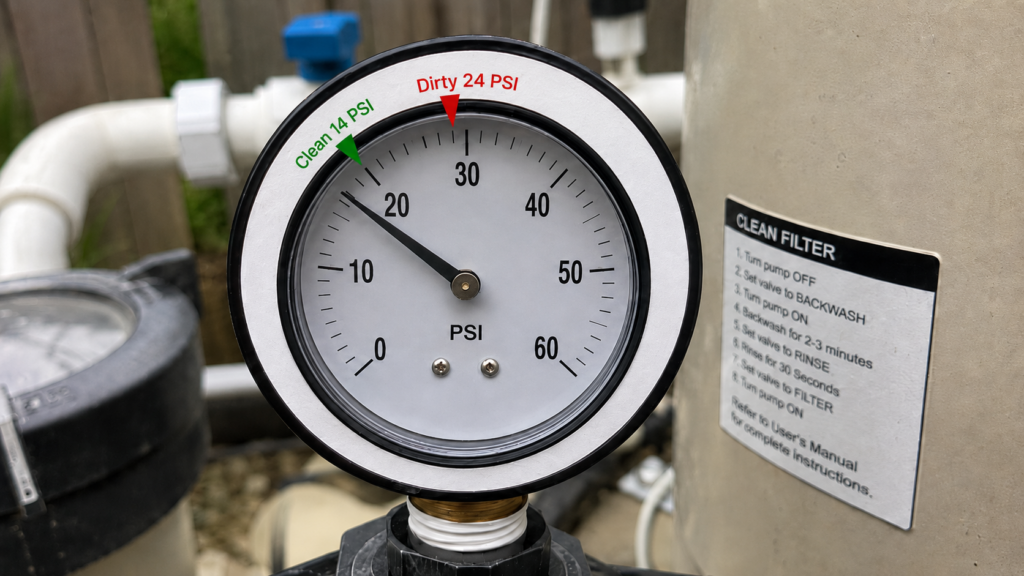
The second step: know, allow “operation fluctuation” (O)
In daily use, the water pressure will fluctuate a little.
For example, if you turn on a waterscape fountain, activate a SPA massage nozzle, or pump water onto a solar panel to heat it, the water pressure will briefly rise by 2 to 4 PSI. This is purely normal operating fluctuations, no fuss. What you really need to keep an eye on is whether the base pressure is secretly rising in the most common daily filtering mode of the system.
Step 3: Touch the “critical point” and it’s time to work (T)
The tipping point is good, that is, 8 to 10 PSI above your cleaning baseline.
When sediment, human body grease and various sundries block the filter medium, the water pump has to use the strength of milk to put the water pressure in the past. If your baseline is 14 PSI, the tipping point is 22 to 24 PSI. What should the pressure gauge look like at this time? It is actually already “screaming” at you for help. Once you reach this critical point, don’t think about anything, go back and flush or flush the filter element.
“2-5 PSI” Episode Brought By Variable Speed Water Pump (VSP)
With the introduction of new energy-saving standards, variable speed water pumps (VSP) are now standard, which has completely overturned the way we look at pressure gauges.
In the previous single-speed water pump, the rotating speed was fixed at 3450 RPM (rpm), the water output was the largest, and the reading of the pressure gauge was high and stable. But the variable speed pump is different. In order to save electricity, it will constantly switch the speed during the day. When it drops to a low speed cycle (such as 1500 RPM), the pressure reading will drop off like a cliff.
Many people who have just installed the swimming pool look at it and see that the watch needle is lying on 2 or 3 PSI when filtering at low speed at ordinary times, and they are scared into a cold sweat. In fact, relax, for low speed variable speed pump, this is normal. To measure the real pressure, you just need to temporarily turn the pump to the highest speed and then compare your baseline.
How To Check If The Water Pressure Is Too High? (More Than 10 PSI Above The Baseline)
The pressure is too high, indicating that the “water outlet” (pressure side) of the pipeline is held, and the water is stuck behind the pump.
The filter media is too dirty: 90% of the time this guy is to blame. Either the sand jar is full of mud, or the diatomite mesh is full of oil, or the paper filter is completely dead. Clean quickly.
The return valve is closed: someone may have accidentally touched the Jandy valve on the return pipe and cut off the water flow back to the swimming pool. Check to make sure that all valves facing the return water nozzle are fully open.
Heater pipe blockage: If you bypass the heater, the pressure will return to normal in an instant, which means that the heat exchanger inside the heater is full of scale (calcification) and should be washed with pickling.
| Gauge Reading | Primary Suspect | Action Required |
|---|---|---|
| +10 PSI over baseline | Dirty Filter | Backwash or clean cartridges. |
| +15 PSI over baseline | Closed Return Valve | Open all return lines immediately. |
| Drops below baseline | Clogged Skimmer/Basket | Empty skimmer and pump baskets. |
| Reads 0 PSI while running | Clogged Impeller / Air Leak | Check pump lid O-ring and impeller. |
How To Check If The Water Pressure Is Too Low? (Below The Baseline)
The pressure is too low, indicating that the problem lies in the “suction end” (suction side). Before the water enters the filter, the pump is already “thirsty.
The skimmer or pump filter is blocked: the leaves are stuffing the filter basket so hard that water cannot flow in. The water pump can only dry suction air, and the pressure of the filter naturally drops to almost zero. The solution is simple: empty all the baskets.
The impeller of the water pump is stuck: sometimes pine needles and small stones become fish that slip through the net and slip in along the gap to jam the rapidly rotating impeller in the water pump. In this case, you will hear a low buzzing sound from the water pump, the water flow at the outlet is very weak, and the pressure gauge reading is abnormally low.
Air leakage at the suction end: take a closer look at the transparent pump cover. If what you see is not a full flow of water, but a huge bubble or water churning in it, then there must be air running into the system. Check the O-ring of the pump cover, apply some Teflon swimming pool grease, and then tighten the cover.
Beware Of The “Zombie Watch” Trap: Don’t Destroy The Filter For A $10 Part.
If you want to know what the pressure should be, you must have a correct watch. However, the pool pressure gauge is really too easy to break.
In winter, 1 the water left in the brass joint freezes, it will deform the Bordon tube brace inside, and as a result, the pointer will be permanently stuck at 15 PSI. You may be checking every month, looking at your watch and thinking that the water is clean, and then one day there’s an algae crisis-because your filter is already clogged to death.
Teach you a “finger test”: turn off the pump completely. At this time, the watch needle must fall back to zero. If the pump stops and the watch still shows 10 PSI, congratulations, you ‘ve met a “zombie watch. Hurry up and throw it into the trash and spend $10 or so to replace a liquid-filled pressure gauge (the liquid filled in can absorb the vibration of the pump and last at least twice as long).
Frequently Asked Questions (Newcomers Love To Ask)
Q: How much pressure should I backwash the pool?
Answer: As long as the pressure gauge is 8 to 10 PSI higher than your original “clean baseline”, it is time to backwash. For example, if your initial pressure is 15 PSI, when it rises to 23 to 25 PSI, do it quickly.
Q: Is a pool filter pressure of 30 PSI too high?
Answer: Absolutely. For most family swimming pools, 30 PSI is an extremely dangerous signal, indicating that the blockage is very serious. Hard rotation under the pressure of 30 PSI will press the dirty things back into the swimming pool, overload the motor, and even crack the shell of the filter in severe cases.
Q: Why is the pressure still very high after backwashing?
Answer: If the pressure still cannot drop after washing, your filter medium is completely broken. It may be that the sand agglomerates and calcifies (forming a channel effect), it may be that the diatomaceous earth mesh is covered with sunscreen and grease (it needs to be cleaned with a special chemical degreaser), or it may simply be that the paper filter element is too old and should be replaced with a new one.
Q: Does a skimmer that is too dirty cause the water pressure to be too low?
Answer: Yes. If the skimmer’s basket is full of fallen leaves, the pump won’t be able to suck in water. Since not much water is pushed into the filter tank, the value measured by the pressure gauge will naturally be much lower than usual.
Q: Why is the water pump on but the pressure gauge is 0?
Answer: The reading of the pump is 0 during operation, which means that there is either a serious air leakage at the suction end, or the impeller of the pump is completely stuck, or your pressure gauge is broken. Before buying a new watch, first touch the backwater nozzle to see if there is really water flowing out.
Q: Do I have to use a liquid-filled pressure gauge?
Answer: Although it is not necessary, the filling table is definitely much better than the dry table. The glycerin in the case can effectively buffer the vibration caused by the water pump, which can not only prevent the pointer from jumping and make your reading easier, but also greatly extend the service life of the pressure gauge.