 Dypressuregauge
Why Are Pressure Gauges Filled With Glycerine? Top Benefits
Why fill the pressure gauge with glycerin? To put it bluntly, it is mainly to resist severe mechanical vibration, eliminate rapid pressure pulses, and provide continuous lubrication for the internal spring tube (Bourdon tube) and gear mechanism. This high-viscosity liquid is like a shock absorber, which can stabilize the pointer that was shaking so that people can’t see it at all, so as to accurately indicate the reading. In heavy industrial environments such as hydraulic presses and high-pressure pumps, the installation of a liquid-filled pressure gauge can extend the service life of the equipment by 50 times.
We have done a thorough investigation on the failure rate of many heavy manufacturing plants, and found that it is not enough to know “why glycerin is added to the pressure gauge. Often because of an inconspicuous installation error, directly led to 40% of the pressure gauge scrapped in advance. Next, we will thoroughly disassemble the liquid-filled pressure gauges for you from an engineering point of view, tell you under which scenarios they can beat ordinary dry gauges, and install dead ends that your maintenance team must not step on.
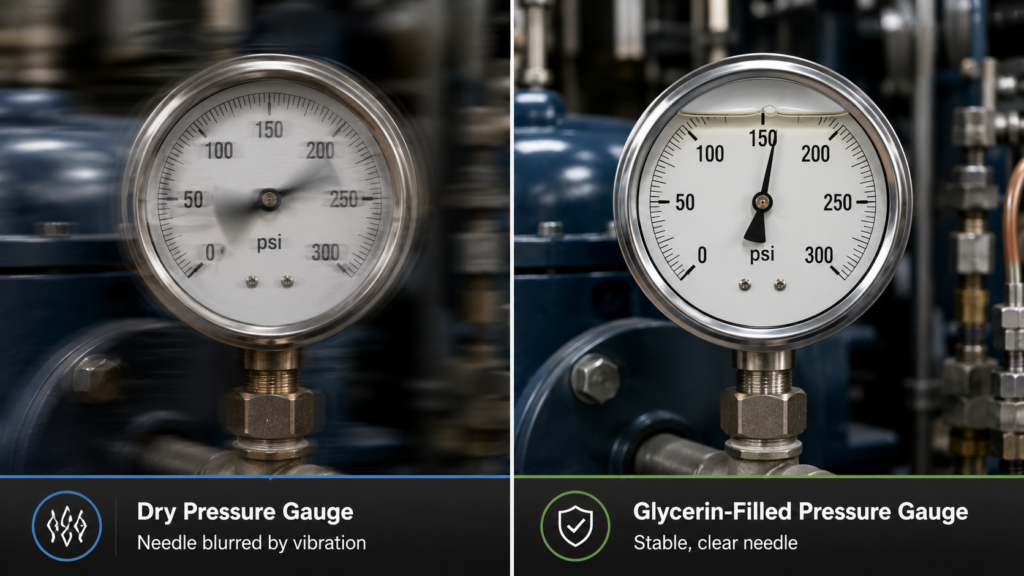
The Mechanical Principle Of Secret: Why Is Glycerin Installed In The Pressure Gauge?
Liquid-filled technology directly hits the two major culprits of mechanical watch damage: dynamic load and sports wear. The standard pressure gauges on the market rely on a 1 C- type spring tube connected to an extremely precise rack and pinion system. Once it is connected to a reciprocating pump or a very vibrating compressor, these small gears made of brass or stainless steel have to withstand thousands of micro-shocks per minute.
The role of glycerin is to wrap these moving parts with a dense, sticky barrier. Whether it is external machine vibration (pipe sloshing) or internal pressure pulses (pressure spikes generated by the fluid medium), this layer of liquid can absorb excess kinetic energy. The pointer stopped shaking instantly. The operator can see the reading at a glance and no longer has to “blindly guess” the average by staring at the crazy scurrying pointer.
Continuous lubrication, life directly soared by 300
With the moment of glycerin in the case, the hard friction between the metal parts disappears completely. If the ordinary dry meter is thrown into a high pulse environment, the sector gear will be scrapped in a few months, and finally the pointer will be completely “stopped”. The viscosity of glycerin allows the pinion to remain lubricated all the time, thus minimizing mechanical wear.
Eradication of internal fogging and condensation
Humid industrial environments can often destroy dry watches from the inside. 1 the ambient temperature drops, the moisture enclosed in the table will condense on the inside of the table glass, which will not only make people unable to see the scale, but also corrode the movement over time. If you fill the case with glycerin, you can squeeze out all the oxygen and humid air. Without air, naturally there will be no condensation, no matter how wet the factory, the dial will always be clear.
V. I .P. Pressure Gauge Selection Rule
Many engineers waste a lot of money because they choose the wrong pressure gauge. We have summarized a set of “V.I.P. rules”, which are specifically used to determine when glycerin meters must be used and when dry meters or silicone oil meters are enough.
V.I.P Matrix
| V (Vibration Load) | I (Internal Condensation Risk) | P (Pulsation Frequency) |
| Low / No Visible Vibration Dry or Silicone gauge suffices. | Indoors / Dry Environments Dry or Silicone gauge suffices. | Steady Pressure (No Spikes) Dry or Silicone gauge suffices. |
| Pipe Shakes Visibly to Naked Eye Liquid filling is non-negotiable (Glycerine or Silicone required). | Outdoors or Wash-Down Areas Glycerine is mandatory (displaces internal air). | Sudden Pressure Spikes Standard Glycerine is mandatory. |
| Extreme, High-Frequency Spikes Glycerine gauge + Mechanical Snubber required. |
V-Vibration (external vibration): If the naked eye can see that the installation pipe is shaking, it is not negotiable, and a liquid filling meter must be used.
I-Internal Condensation (internal condensation): If the equipment is outdoors in the sun or in a place that needs frequent washing (such as a food processing factory), it is right to choose a glycerin meter to squeeze out the air inside.
P-Pulsation (internal pulse): For those hydraulic systems with pressure spikes from time to time, a conventional glycerin meter is sufficient to cope with ordinary pulses. But if you encounter extreme high-frequency shocks, you have to match the glycerin watch with a mechanical buffer (damper).
A Common Pit In The Industry: The “Zero Offset” Disaster Caused By The Relief Plug
Forgetting to exhaust the case is definitely the most common low-level mistake for novice maintenance workers. In order to prevent leakage on the transportation road, the top of the liquid-filled pressure gauge will be plugged with a tight rubber plug when leaving the factory. This plug usually has a small bump or label on it.
As soon as the table is installed and run, the glycerin inside will expand due to heat due to the influence of the ambient temperature and the temperature of the medium in the pipeline. If the maintenance master hadn’t cut off the small tip of the rubber plug, there would be no place for the expanding liquid to go. As a result, the pressure inside the case will soar, squeezing the spring tube from the outside. This external pressure will force the pointer to run up, causing the machine to stop, but the watch still shows a pressure of 5 to 15 PSI. Remember: after installing the watch, immediately cut off the small tip of the pressure relief plug (or open a mouth) to keep the atmospheric pressure inside and outside the watch case in balance.
Viscosity Standard Under The New Regulations: Pure Glycerin PK 86.5 Mixed Solution
It is temperature, not price, that determines what liquid should be added. Many people have a misconception that 100 percent pure glycerin is the industrial standard. In fact, pure glycerin (99.5%) will crystallize at 17°C (63 °F) and become almost solid, freezing the pointer to death in place.
Modern high-performance pressure gauges use a mixture of 86.5% glycerin and 13.5% distilled water. This perfect ratio lowers the freezing point significantly, allowing the pressure gauge to remain accurate in an environment of minus 20°C (-4 °F). However, if the temperature in your factory is colder than -20°C, then don’t expect glycerin to change silicone oil directly. It can still maintain stable viscosity in the severe cold of minus 40°C.
First-Line Measured Data: Shockproof Test Of 500-Ton Hydraulic Press
Whether the liquid-filling meter can save money or not depends on the test of real knives and guns on site. In a recent maintenance inspection of a 500 ton hydraulic press operating at 3,000 PSI, we spent 12 months tracking the survival rate of the pressure gauge.
Ordinary dry table: under the torture of hydraulic impact, the sector gear is broken, and the average is broken every 14 days.
Liquid filling (glycerin) meter: it has been as stable as an old dog for 18 consecutive months, and the calibration accuracy has not deviated at all. This not only increased the running time of the meter by 3600, but also saved more than $4200 in meter replacement fees for each machine in the factory.
Frequently Asked Questions (You May Also Want To Ask)
Can I add glycerin to the pressure gauge myself?
Absolutely. If you find a leak, unplug the rubber plug at the top and fill up the liquid. However, don’t fill it up too much. About half an inch (about 1.3cm) of air should be left at the top to make room for the liquid to expand due to heat.
What happens if the glycerin pressure gauge leaks?
If there is a slight leakage of liquid, the dial will be stained with oil and a big bubble will 1 inside. As long as the liquid level is not lower than the internal mechanical gear, the reading is still accurate. However, if all the liquid leaks and the machine shines 1, the watch will not be far from being scrapped.
Is the glycerin in the pressure gauge toxic?
It’s not poisonous. Industrial glycerin is not only non-toxic and harmless, but also water-soluble and safe in most environments. However, if it is used in a specific food-grade factory, in order to completely eliminate the hidden danger of pollution, it may have to be replaced by a special filling liquid according to FDA standards.
Why is there a big bubble on the top of my glycerin watch?
The bubble was deliberately left by the manufacturer. When leaving the factory, the watch case would not have been filled with 100 percent. The purpose of keeping this mass of air is to prevent glycerin from expanding when the temperature of the factory building becomes higher, and to support the dial glass to explode.
Can a glycerin meter be used on an oxygen tube?
Absolutely not. Don’t even think about it! When glycerol meets high-purity oxygen, a violent chemical reaction occurs. A glycerin meter on the oxygen line is no different from putting a time bomb. To measure oxygen, you must use a dry table that has been specially degreased and cleaned, or a special table filled with halocarbon (Freon) inert liquid.
How to clean glycerin pressure gauge turbid?
The muddy inside the table is usually caused by glycerin absorbing moisture or being deteriorated by strong ultraviolet rays. You can’t “wash” this liquid. The only way is to empty the residual liquid in the case, rinse it off, and refill it with fresh 86.5% mixed glycerin.