 Dypressuregauge
Absolute vs Gauge Pressure: Vital Differences Defined
Absolute pressure (absolute pressure) uses an ideal vacuum as the lightning-fast zero point, while gauge pressure (relative pressure) uses the local atmospheric pressure, which constantly fluctuates, as the zero point reference. To clarify the mathematical relationship between the two, just remember an extremely simple formula: absolute pressure = gauge pressure + local atmospheric pressure (Pabs = Pgauge + Patm).
When choosing a plant transmitter, if you get the reference benchmark wrong, your process variables will be off by about 14.7 psi (1 bar). This level of calibration error is sufficient to cause the tank to rupture or trigger an unplanned safety interlock stop. This article will provide an in-depth analysis of how local weather changes “undercover” low-pressure gauge pressure readings, and provide you with a set of engineer-tested instrument selection guidelines.
Core Formula: Find The Reference Point
Whether the zero-point benchmark is set correctly directly determines whether the measured pressure change data is accurate and reliable, or a bunch of useless code. The baroclinic measurement is based on an unshakable foundation (absolute zero). The gauge pressure measurement is as if it “floats” above the ambient air pressure, undulating with the weight of the air pressing on the sensor at that time. When young engineers come to ask “what exactly is the difference between gauge pressure and absolute pressure”, they tend to overlook the fact that atmospheric pressure itself is extremely unstable.
| Measurement Type | Reference Point | Values Under Vacuum | Symbol | Typical Applications |
|---|---|---|---|---|
| Absolute Pressure | A fixed vacuum reference (absolute zero pressure) | Absolute pressure remains positive and measures the true pressure above a perfect vacuum | psia (pounds per square inch absolute) | Vacuum chambers, semiconductor processing, meteorology, scientific experiments, sealed systems |
| Gauge Pressure | Ambient atmospheric pressure at the measurement location | Gauge pressure can show negative values when the pressure is below atmospheric pressure | psig (pounds per square inch gauge) | Open tanks, pipelines, pumps, compressors, hydraulic systems, industrial process monitoring |
| Vacuum Pressure | Atmospheric pressure as the reference point below ambient pressure | Measures the amount of pressure reduction below atmospheric pressure | inHg, Torr, or negative psig | Vacuum systems, refrigeration, vacuum pumps, laboratory equipment |
For atmospheric open tanks and processes exposed to open atmosphere, gauge pressure sensors must be strictly used. Because the liquid level in the open tank is directly connected to the atmosphere, the sensor at the bottom must also use the atmosphere as a reference to calculate the true hydrostatic head. If you mistakenly install a pressure relief sensor on an open tank, you’re in trouble: every time a high-pressure weather system (like a clear high-pressure front) passes through, your DCS (Distributed Control System) will signal a false level rise.
In The Field, What Is The Hardware Difference Between Gauge Pressure And Dead Pressure?
The gauge pressure sensor is usually designed with a small vent hole to allow the back of the pressure-sensitive diaphragm to directly contact the ambient air. This mechanical design directly deducts the effects of atmospheric pressure at the physical level. The absolute pressure sensors do not have this vent hole; their diaphragms are completely sealed, and a high vacuum is encapsulated on the back, which strictly isolates the inside of the instrument from the external environment.
“Barometric Traps” In Low-Pressure Systems
Meteorological changes are simply low pressure gauge pressure measurements “natural enemies”. Atmospheric pressure can fluctuate by up to 0.5 psi (34 mbar) due to altitude, temperature, and weather fronts. If on a long transmission line operating at a pressure of up to 1000 psi, the error caused by the 0.5 psi air pressure fluctuation is only an insignificant 0.05%. But in a low-pressure oil and gas recovery line operating at just 3 psi, the same weather change would trigger a data surge of up to 16.6% ——a completely false signal. The baroclinic transmitter can completely ignore these weather systems and provide indispensable stable data for accurate low-pressure gas monitoring.
Vacuum Working Condition: Must Be Pressed Out Of Pressure
For equipment like vacuum distillation columns and industrial freeze dryers, a barstressed pressure transmitter is the only option. You can’t reliably measure vacuum with a gauge pressure sensor because its reference line (atmospheric pressure) keeps running around. If you use a gauge pressure sensor to measure a -12 psig vacuum system, the data measured on rainy days and sunny days will definitely be different. The barstressed transmitter measures the vacuum process as a positive value above absolute zero, completely eliminating benchmark drift and ensuring a high degree of consistency in product quality from batch to batch.
“Three Principles Of Zero-Point Benchmark ” Mental Model
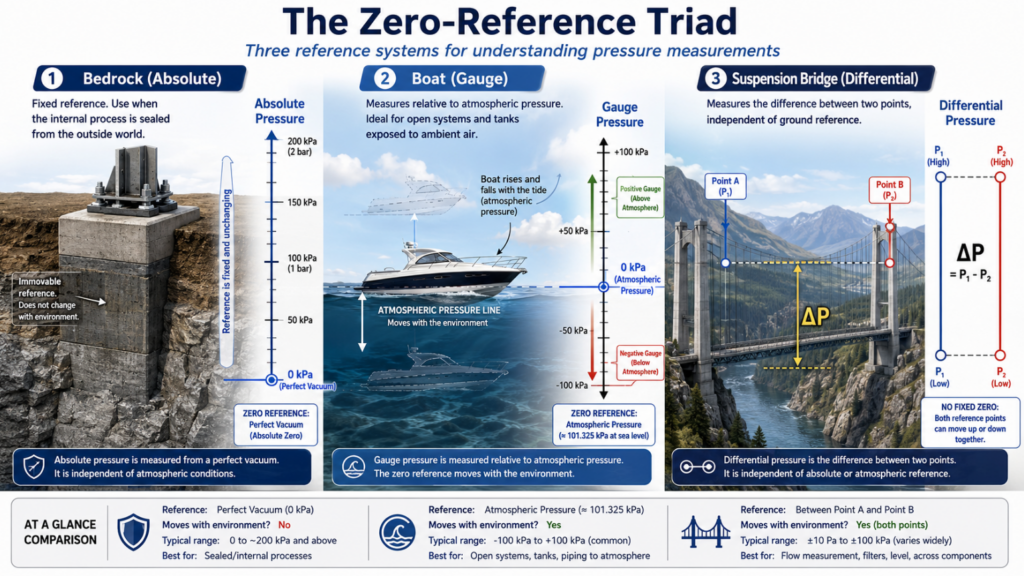
To prevent the selection from falling over, we can build a mental system “the three zero-point benchmark principles” and imagine the pressure type as a different building structure:
Bedrock (barrel pressure): Like a concrete base deeply rooted in the ground, it remains motionless. Use it when the internal process is completely isolated from the outside world.
Small boat (gauge pressure): Like a boat floating on the sea. The tide (atmospheric pressure) rises and falls, and the boat follows. Use it when your craft is exposed to the same “tide” (like an open can.
Suspension bridge (differential pressure): only the difference between two independent active points is measured, regardless of the earth beneath the feet.
Field Case: Weather-Induced False Alarm For Oil And Gas Recovery
Under the modern Industrial Internet of Things (IIoT) architecture, using the wrong reference can lead to real financial losses. In October 2024, a 4 psi closed flare gas recovery line at a petrochemical plant in Texas frequently reported a false leak alarm. The instrumentation team initially installed a conventional gauge pressure transmitter. During the transit of Hurricane Beryl, the local air pressure plummeted, causing the atmospheric baseline to drop by 0.6 psi in an instant. Because the external environmental resistance becomes weaker, the gauge pressure transmitter immediately measures a sudden surge in internal pressure. Later, we replaced all the instruments with absolute pressure transmitters and wrote a program in the PLC to subtract 14.7 psi. The data instantly returned to stability, which fully proves that the closed low-pressure condition must be monitored by absolute pressure in order to withstand the interference of extreme weather.
How To Choose The Right Transmitter For Your Process
Select absolute pressure instrument: when measuring any closed gas system, vacuum process or altimeter application. Anyway, the closed environment doesn’t care if it’s windy or rainy outside.
Optional gauge pressure instruments: when measuring open liquid level, pneumatic tools or pump outlet lines. Because the pump must work against the local atmospheric pressure, the sensor must account for this local resistance factor into the reading.
Frequently Asked Hard Questions (FAQs)
Is absolute pressure or gauge pressure used to measure blood pressure?
It’s gauge pressure. Sphygmomanometers measure the pressure inside your blood vessels, relative to the difference in the external atmospheric pressure that presses on your body surface.
Can gauge pressure be negative?
Of course it can. Negative gauge pressure represents a vacuum-that is, a pressure lower than the surrounding atmospheric pressure. For example, a vacuum pump pumps up to -5 psig, indicating that it is operating below the local atmospheric pressure baseline.
Can absolute pressure be negative?
Absolutely not. The bottom line of absolute pressure is absolute zero (perfect vacuum). There is no state of stress in the physical world that is lower than “not even a bit of matter.
Why does the tire pressure gauge read zero before the valve core is plugged in?
Because the tire pressure gauge measures the gauge pressure. When it is not connected, the pressure inside the barometer is as large as the ambient atmospheric pressure outside. The mechanical forces on both sides cancel each other out, and the pointer naturally stops at the position of completely zero.
What effect does altitude have on a gauge pressure transmitter?
The altitude directly determines the atmospheric pressure. A gauge pressure transmitter calibrated at sea level (ambient pressure 14.7 psi) will definitely drift if it is pulled directly to Denver at high altitude (ambient pressure about 12.1 psi). Because the vent is exposed to thinner air, if not re-calibrated locally, all subsequent field measurements will be systematically biased.
What if I had to put an absolute pressure sensor in an open tank?
The signal given by this sensor will be the “superposition” of the hydrostatic pressure of the liquid and the weight of the atmosphere pressing on the top of the tank “. In order to strip the true liquid level from this mass of data, your control system has to collect local dynamic air pressure data in real time and constantly subtract from the output of the sensor. Just asking for trouble.