 Dypressuregauge
Compound Pressure Gauge vs Vacuum: Crucial Differences
The function of the vacuum gauge is very single, specifically used to measure the negative pressure below the local atmospheric pressure. The composite pressure gauge integrates the measurement of positive and negative pressure on the same dial. In the actual refrigerant recovery operation, every year hundreds of pure vacuum gauges are instantly scrapped due to accidental positive pressure impact, which is often caused by the negligence of on-site technicians. Therefore, in order to avoid complete damage to the instrument and the subsequent misdiagnosis of the system, it is necessary to understand the internal mechanical limits of the instrument and make it strictly match the physical characteristics of your pipeline system.
What Is A Composite Pressure Gauge
Compound pressure gauge is the 1 kind of two-way working instrument. Its dial usually sets the zero point (that is, atmospheric pressure) slightly to the left. The pointer goes counterclockwise, which represents the vacuum degree (the unit is usually inches of mercury, inHg); Clockwise, it represents positive pressure (the unit is usually PSIG or bar).
The manifold table group used by HVAC masters is absolutely inseparable from the composite table. Take the repair of household air conditioners as an example. The master must first vacuum the empty pipeline to drain the water, and then immediately fill the high-pressure refrigerant. With the composite meter, the whole process is completed in one go, and there is no need to disassemble the meter in the middle. It can firmly withstand the extreme pressure conversion from -30 inHg to more than 300 PSIG in an instant.
| Gauge Type | Measurement Range | Needle Movement | Primary Use Case | Risk of Positive Pressure Blowout |
| Compound Pressure Gauge | Both negative vacuum (e.g., down to -30 inHg) and positive pressure (e.g., up to 300+ PSIG / bar) | Dual-directional (Counter-clockwise for vacuum, clockwise for positive pressure) | HVAC servicing (pulling vacuums and charging high-pressure refrigerant) | Low (Safely absorbs violent transitions from deep vacuum to high positive pressure) |
| Vacuum Pressure Gauge | Solely negative pressure (below the local atmospheric baseline) | Uni-directional | Pure vacuum applications (degassing, vacuum-sealing, extracting air) | High (Catastrophic instrument failure when exposed to sudden positive pressure surges) |
What Is Vacuum Gauge Pressure
Pure vacuum gauge is a typical one-way instrument. Its zero point is set on the far right or directly above the dial, and the pointer can only turn in one direction, specifically for reading negative gauge pressure.
This pure vacuum gauge is used by industrial vacuum pump operators and laboratory personnel when making degassing chambers or vacuum seals. When the manufacturer designs, the internal C- type Bourdon tube (spring tube) is set to contract only under negative pressure. This special design makes it highly magnified and extremely accurate when measuring low to medium vacuum. However, it is also because of this that as long as a positive pressure of even 10 PSI is applied to the pure vacuum gauge, the internal Baudon tube will be permanently deformed and the whole gauge will be scrapped directly.
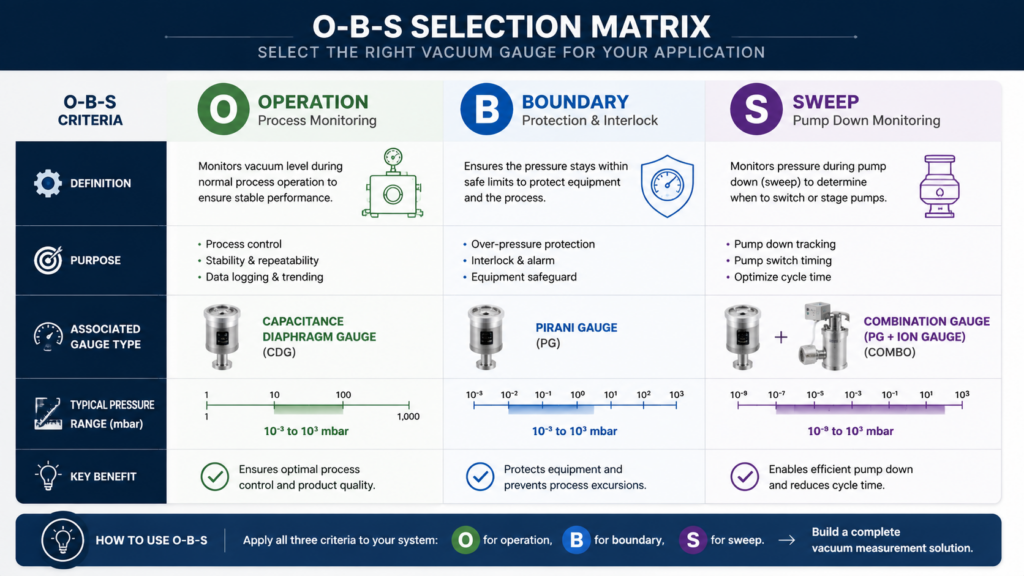
O-B-S Selection Matrix: Instrument Specification Selection Framework
Selecting the wrong table is no joke, it is directly related to system security. So before installing the meter, engineers usually use the O-B-S (operation-boundary-range) matrix to force themselves to figure out what the system needs.
Operating direction (Operation Direction)
First of all, we must find out the direction of the fluid. If your pipeline is purely pumping out and will never enter high-pressure gas, then install a pure vacuum gauge directly. However, if the system needs to switch back and forth between vacuum and pressure (such as chemical batch reactor or refrigeration cycle system), there is no choice, must be on the composite table.
Boundary Limits
Figure out what the absolute maximum pressure spike your system can produce is. You know, Bunden tube can only maintain accuracy for a long time if it works in the range of 30% to 70% of the total full scale. For example, if your refrigeration system uses A2L refrigerant, and the pressure can soar to 400 PSI at high temperature in summer, then the upper limit of the composite meter you choose must be at least 600 PSI, so as to prevent internal mechanical fatigue.
Range Scale (Sweep Resolution)
Assess your requirements for the clarity of the dial scale. Composite watches had to sacrifice partial vacuum resolution in order to plug the positive pressure scale on the limited dial. The negative pressure scale of the pure vacuum gauge has a large span and the reading is clear at a glance. Therefore, if your only goal is to keep an eye on the exact vacuum pressure drop, the vacuum gauge is right.
The Pit That Experts Will Step On: How Technicians Destroy The System.
Both the laboratory data and the first-line failure rate show gory that 80% of the subsequent collapse of the system is caused by human error in the vacuum pumping process. Many technicians repeatedly misjudge the mechanical limits of the instrument itself.
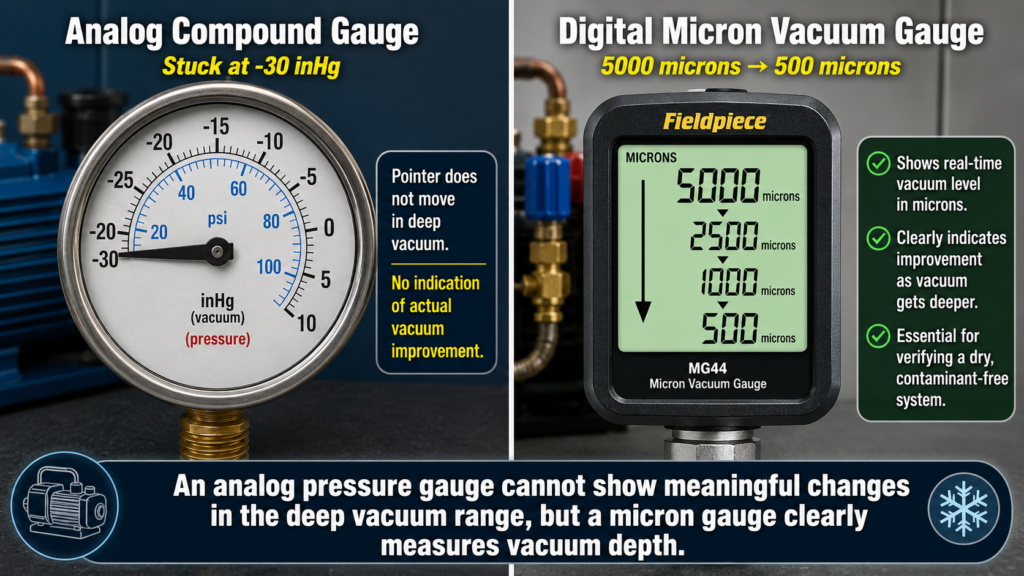
“Micron Blind Zone” of Composite Tables”
If you rely on a pointer-type mechanical composite meter to confirm the depth of the vacuum, then I can guarantee that the system will be contaminated sooner or later. The pointer of the mechanical composite meter reached -30 inHg in the end. The masters 1 saw that the pointer was bottomed out and thought the pipeline was completely dry. Someone has done a field test on a commercial 5 ton chiller: at that time, the mechanical composite meter showed “perfect” -30 inHg, but after connecting the piezoresistive digital micron vacuum gauge on the same interface, the reading was as high as 3,500 microns! This means that there is still a lot of water vapor churning in the system. Remember, if you want to confirm that the system is really dehydrated to a depth of vacuum below 500 microns, you must never rely on a mechanical composite table, and you must use a dedicated digital micron vacuum gauge honestly.
valve block trap
The wrong valve can make the delicate vacuum meter disappear in an instant. One mistake that masters often make is that the digital vacuum gauge is still hung on the inspection port, and the positive pressure valve on the high pressure side is opened to release the liquid refrigerant. The sudden 350 PSI shock wave can shatter the fragile thermistor sensor in the vacuum gauge in a second. Therefore, before passing positive pressure into the pipeline, don’t be too troublesome. You must use the thimble valve to physically isolate the pure vacuum detection tool or simply remove it.
Industry Trends: Hybrid Digital Manifold Tables
Today, modern HVAC and industrial processing areas are slowly phasing out purely mechanical dials. Today’s manufacturers are smart enough to directly integrate discrete piezoresistive vacuum sensors into the main body of the positive pressure digital manifold meter. This kind of hybrid design is too practical. The master stares at a LCD screen, which can not only see the huge positive pressure peak (for example, the R-32 system can reach 800 PSI), but also see the depth of vacuum (as low as 10 microns). Best of all, it completely ends the risk of the Bendon tube being blown up during a state switch.
Frequently Asked Questions (FAQs)
What does the compound pressure gauge read?
It can read both positive gauge pressure (the part above atmospheric pressure) and negative vacuum pressure (the part below atmospheric pressure). The positive pressure unit of most dials in the industry is PSIG or bar, and the negative pressure unit is inches of mercury (inHg).
Can I take a vacuum gauge to measure the positive pressure?
Absolutely not. A vacuum gauge is a measure of negative pressure. Once it is subjected to positive pressure, the internal mechanical structure will be forced to support the limit, and its calibration accuracy will be completely destroyed.
Why can’t my composite table pointer probe below -30 inHg?
At sea level,-29.92 inHg already represents a perfect absolute vacuum. A mechanical dial cannot physically display a lower negative gauge pressure at all, because you can’t always drain 100 percent of the atmosphere in the tube and then pump out a little more.
What is the difference between absolute pressure and vacuum gauge pressure?
The vacuum gauge pressure is based on the zero point of your local atmospheric pressure. And the absolute pressure is based on the perfect vacuum as the zero point, up. An absolutely perfect vacuum, expressed in absolute pressure, is 0 PSIA, which translates to about -14.7 PSIG in gauge pressure.
How should the composite pressure gauge be calibrated?
The technician usually uses a pneumatic static weight tester, or a high-precision digital reference standard. This watch has to be measured back and forth twice: first use a vacuum pump to measure its negative pressure stroke, and then use compressed nitrogen to measure its positive pressure stroke. Only in this way can the internal linkage mechanism maintain linear accuracy in the entire range.
hvac best with what table?
Preferred digital micron vacuum gauge. Because to completely boil and drain the residual water in the refrigeration system, the vacuum must be pumped below 500 microns. The mechanical composite table does not have such a high physical resolution at all and does not show such a deep vacuum level at all.