 Dypressuregauge
Atmospheric Pressure vs Gauge Pressure: Conversion Secrets
Let’s get straight to the point: gauge pressure measures how much the fluid’s force on the container exceeds the external atmospheric pressure. To convert absolute pressure to gauge pressure, the formula on paper is straightforward: subtract your local, precise atmospheric pressure reading from the absolute pressure (Pgauge = Pabs − Patm). However, every day, numerous technicians render expensive compressors inoperable and produce grossly erroneous thermodynamic calculations—simply because they treat 14.7 psi (101.325 kPa), the sea-level standard, as an immutable law of nature. This is simply not realistic. Just the arrival of a weather front or a change in elevation is enough to render this reference value completely invalid. Next, we will thoroughly explain how to truly master local pressure conversions, expose the altitude pitfalls that are undermining modern HVAC equipment, and guide you step by step on using the “C.A.P. Matrix” to ensure your fluid dynamics calculations are foolproof.
Core Algorithm: Accurate Conversion from Absolute Pressure to Gauge Pressure
What is the golden rule for converting atmospheric pressure to gauge pressure? Always use real-time local data—don’t rely on dusty textbooks and rigid, fixed constants. From the formula Pgauge = Pabs-Patm, it can be seen that the gauge pressure is basically the total energy (absolute pressure) possessed by the system, minus the thick layer of “air blanket” pressing on the meter. Subtract 14.7 psi directly with your eyes closed? This bet can only be won
Atmospheric Pressure to Gauge Pressure: Altitude Error Matrix
| Elevation | Standard Atmospheric Pressure (PSIA) | Gauge Conversion Factor (PatmPatm to subtract) | Resulting Error Margin if 14.7 PSIA is used |
| Sea Level (0 ft) | 14.70 PSIA | – 14.70 PSI | 0.00 PSI (Baseline) |
| 1,000 ft | 14.17 PSIA | – 14.17 PSI | 0.53 PSI deviation |
| 2,000 ft | 13.66 PSIA | – 13.66 PSI | 1.04 PSI deviation |
| 3,000 ft | 13.17 PSIA | – 13.17 PSI | 1.53 PSI deviation |
| 4,000 ft | 12.69 PSIA | – 12.69 PSI | 2.01 PSI deviation |
| 5,000 ft | 12.23 PSIA | – 12.23 PSI | 2.47 PSI deviation |
| 6,000 ft | 11.78 PSIA | – 11.78 PSI | 2.92 PSI deviation |
| 8,000 ft | 10.91 PSIA | – 10.91 PSI | 3.79 PSI deviation |
| 10,000 ft | 10.11 PSIA | – 10.11 PSI | 4.59 PSI deviation |
when you are standing on a cloudless beach. As long as you’re touching a fluid line under pressure, you have to look at a real barometer. Think about it: if 1 storm suddenly blows and causes the local air pressure to drop by 0.5 psi, even if the fluid in the pipeline does not move, your gauge pressure reading will soar by 0.5 psi out of thin air. If you hadn’t zeroed those differential pressure transmitters every day, your baseline would have drifted to nowhere.
Atmospheric Pressure and Gauge Pressure: The Fundamental Physical Difference
From a physical perspective, atmospheric pressure and gauge pressure are completely different things. Atmospheric pressure is just the restless and flowing weight of the sky pressing on the earth. However, the gauge pressure stares at the trapped energy in the sealed space to see how strong it is against the external environment. Take a flat bicycle tire as an example. Why is it zero when measured by a meter? The reason is very simple, because the thrust of the air inside is not greater than that of the air outside. Don’t get me wrong, there is still absolute pressure in the tire, it just doesn’t have the extra strength to push the rubber apart.
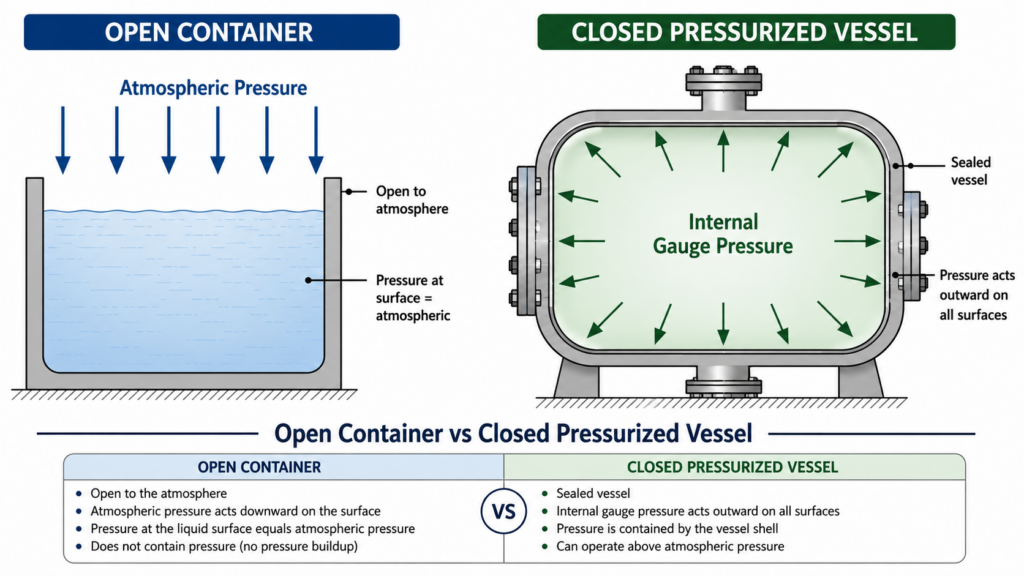
This is why instrument manufacturers drill a physical vent hole in the gauge pressure transmitter. This tiny hole allows the air in the room to push against the back of the sensing diaphragm, while the fluid in your pipe is against its front. When this small piece of silicon or steel is bent back and forth, it completes the subtraction of the two forces at the physical level. To put it bluntly, it is doing this arithmetic problem for you in real time.
Original “C.A.P.” conversion matrix
If the engineering team wants to be able to guarantee conversion accuracy when working across regions, it must honestly implement the C.A.P. conversion matrix. Just memorizing or working with outdated quick-look-up tables will sooner or later lead to a systematic mess in the industrial automation circuit.
- C- calibration benchmark (Calibration Baseline): real-time meteorological data are retrieved through local weather API or on-site barometer before hands-on conversion. Throw the so-called standard value of 14.7 psi / 101.3 kPa directly into the trash can.
- A- Altitude Correction (Altitude Correction): For every 1000 feet increase in altitude, the air pressure is reduced by approximately 0.5 psi. If you build a pumping station in the mountains, the set point of the control loop is absolutely different from the coastal factory.
- P-phase state verification (Phase State Verification): Be sure to confirm that the fluid is approaching boiling point. In the refrigeration system, even if the gauge pressure is only 1 psi wrong, it will completely deviate the boiling point calculation, eventually causing the liquid refrigerant to flow back into the compressor.
Expert’s Pit: High Altitude “Ghost Vacuum”
The direct application of sea-level atmospheric standards to high-altitude gauge pressure conversion is simply a murder of industrial equipment. We just went to Denver, Colorado (5280 feet above sea level) a while ago to review a commercial HVAC contractor who actually burned down 12 scroll compressors in 1 years. Those inexperienced junior mechanics, all by subtracting the dead rule of 14.7 psi to convert the absolute pressure, and use this to calculate the superheat of the system.
However, the actual local atmospheric pressure in Denver tends to fluctuate around 12.1 psi. These people use 14.7 to subtract, rather than real 12.1, resulting in a mathematical “ghost vacuum” appearing out of thin air on their data sheets. Because of this wrong conversion, they habitually charge 18% less every time they fill the air conditioner with refrigerant. The compressor does not get enough return air to cool, and eventually it is directly locked by overheating.
Industry Trend: Dynamic Air Pressure Compensation Technology
Today, modern digital HVAC manifold instruments and industrial SCADA systems have completely ended the error of manual pressure conversion through GPS-bound air pressure compensation technology. The old-fashioned mechanical watch (Borden tube), once moved to a different altitude, the pointer will physically drift. The technicians of the older generation had to reset these analog watches with a flat-head screwdriver before each work.
Today’s digital tools (such as the latest Fieldpiece or Testo smart manifold) have their own atmospheric sensors inside and can also connect to Bluetooth App data. These devices can adjust the zero-point algorithm up to ten times per second, continuously measuring the most accurate local atmospheric pressure. The evolution of this kind of hardware has basically eliminated the manual work of calculating atmospheric pressure to gauge pressure in high-end field services, and now it can only be seen in college physics courses or the underlying system engineering design.
Everyone Is Asking (FAQ)
How Do You Convert Atmospheric Pressure To Gauge Pressure?
Simply subtract the local atmospheric pressure from the system’s absolute pressure. The rigorous formula is Pgauge = Pabs − Patm. To ensure data accuracy, always refer to the local barometer reading and never rely on standard sea-level constants.
What Exactly Is The Difference Between Atmospheric Pressure And Gauge Pressure?
Atmospheric pressure is the weight of the air in the natural environment that surrounds you. Gauge pressure is the portion of pressure remaining in a closed system after subtracting the external atmospheric pressure. If the pressure gauge is left open to the atmosphere, the gauge pressure reading will be zero.
Can Gauge Pressure Be Higher Than Absolute Pressure?
Absolutely not. Gauge pressure is always equal to absolute pressure minus atmospheric pressure. As long as we are on Earth, atmospheric pressure is always positive; therefore, in mathematical terms, absolute pressure must always exceed gauge pressure.
Why Is My Gauge Pressure Reading Negative?
A negative gauge pressure indicates that the pressure inside your system has dropped below the local atmospheric pressure. Engineers typically refer to this particular condition as “vacuum” or “draft pressure.”
Is 14.7 Psi Gauge Pressure Or Atmospheric Pressure?
At sea level, 14.7 PSIA (absolute pressure) is standard atmospheric pressure, representing the weight of Earth’s atmosphere. If you place a pressure gauge without a connection to a pipe on a workbench at sea level, it will read 0 PSIG (gauge pressure).
How Does Altitude Affect Gauge Pressure Readings?
The higher the altitude, the lower the atmospheric pressure. If you move a completely sealed system from sea level to a high altitude, the gauge pressure reading will increase slightly, because the ambient atmospheric pressure exerting force on the instrument from the outside has decreased.