 Dypressuregauge

0 300 PSI Liquid Filled Pressure Gauge: What to Check
When you see the phrase 0 300 psi liquid filled pressure gauge, separate two different specifications. The 0–300 psi range describes the pressure span shown by the dial, while liquid filling describes how the gauge case is damped. They are related to the same instrument, but they do not describe the same feature.
A liquid-filled gauge can be useful when vibration, pulsation, or rapid pressure changes make a dry gauge difficult to read. However, the name alone is not enough to confirm that a gauge will work in a particular installation. The pressure reference, process medium, temperature, connection, installation position, and environmental protection still need to be checked.

What Do 0–300 PSI and Liquid Filling Describe?
In a liquid-filled pressure gauge, the case around the movement is filled with a damping liquid. That liquid surrounds the internal movement and pointer mechanism, helping to slow sudden mechanical movement. It is not normally the pressure medium inside the Bourdon tube or other sensing element, and it is not the process fluid being measured.
This distinction matters during selection. Case filling does not change the pressure reference, the dial range, or the process connection. A gauge may be specified as 0–300 psi and liquid filled, but those are two independent parts of the specification: one defines what pressure the instrument displays, and the other describes how the case helps control movement and protect the mechanism.
The pressure range should also be considered in relation to normal operating pressure. If the process normally runs close to the upper end of the scale, the pointer may spend too much time near full scale. If the operating pressure is very low compared with the selected range, small changes may be difficult to read. The correct range therefore depends on the expected operating pressure, peaks, and the required reading resolution—not on the “liquid filled” description alone.
What Problem Does a Liquid-Filled Gauge Solve?
The main purpose of case filling is to reduce pointer movement caused by mechanical vibration, pressure pulsation, and rapid fluctuations. By increasing resistance around the movement, the liquid helps the pointer settle instead of continuously shaking. This can make the dial easier to read and can reduce the repeated mechanical impact that contributes to wear.
That benefit is especially relevant near pumps, compressors, hydraulic equipment, reciprocating machinery, and other installations where the gauge body is exposed to vibration. A steadier pointer can improve routine checks because an operator can read the approximate pressure without waiting for the pointer to stop moving completely.
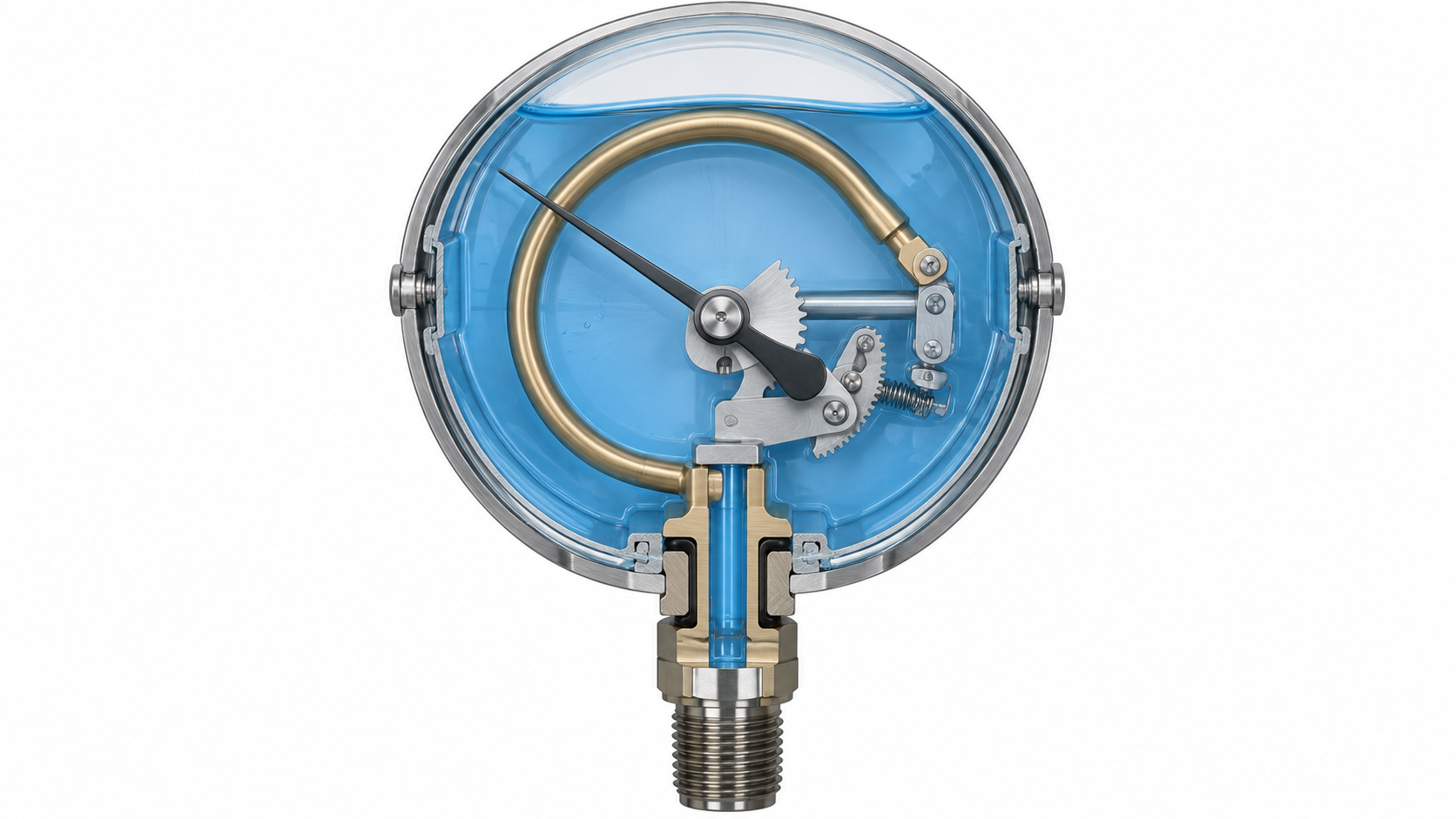
The liquid can also reduce the effects of moisture and condensation inside the case. In some environments, this helps limit internal fogging, corrosion, or frost around the mechanism. These benefits should not be confused with a guaranteed enclosure rating, however. Actual protection depends on the case design, sealing, venting method, ambient temperature, and the environmental grade of the selected model.
A liquid-filled design is therefore a practical damping and protection feature, not a universal solution for every unstable reading. Severe pulsation may still require a snubber, restrictor, pulsation dampener, remote mounting arrangement, or another process-side measure. The instrument should be selected together with the installation, rather than treated as an isolated dial.
Why Case Fill Is Not Process-Medium Compatibility
The liquid in the case and the medium in the process connection must be evaluated separately. Common case-fill options can include glycerin, a water-glycerin mixture, or silicone oil, but these options are not automatically interchangeable between models. The appropriate fill depends on the gauge construction, formulation, viscosity, temperature range, and the manufacturer’s stated limits.
Glycerin is often used for general applications and moderate temperatures. Silicone-based fills may be considered where lower temperatures or wider temperature changes create different viscosity requirements. Those are general selection principles only; the actual boundary depends on the specific formulation and gauge model. The product data sheet and order code should take priority over a general assumption.
The process medium must be checked against the wetted materials of the pressure element and process connection. Important questions include whether the medium is corrosive, whether it contains solids, whether it is clean, how viscous it is, what temperature it reaches, and whether it produces pulsation or pressure spikes. A case fill that works well for the movement does not make the wetted parts compatible with an aggressive or contaminated process fluid.
Leakage risk also deserves attention. If the measured medium must not contaminate the environment, the gauge may need a different material combination, diaphragm seal, chemical seal, or remote installation. The choice of case fill cannot replace that process-safety review.
How to Check Whether 0–300 PSI Fits the Application
Start by confirming the pressure reference: gauge pressure, absolute pressure, or another reference. Then confirm how the pressure is sensed and displayed, including the sensing element, dial units, accuracy requirements, and any need for an electrical or remote signal. A 0–300 psi dial is only useful when its reference and display requirements match the application.
Next check the expected operating pressure, normal fluctuations, transient peaks, and the preferred position of the pointer on the scale. Review the wetted materials, case material, process connection, connection orientation, installation space, and ambient temperature. If the gauge will be exposed to outdoor weather, washdown, dust, corrosive vapors, or condensation, confirm the case protection and sealing details as well.
Finally, decide whether liquid filling is actually the best damping option. A dry gauge may be suitable for a stable, low-vibration installation or where faster pointer response is more important. In other installations, a filled gauge combined with a restrictor or pulsation dampener may provide a better result. The right answer depends on the source and severity of the disturbance.
Use the complete datasheet and order code when placing an order. The phrase 0 300 psi liquid filled pressure gauge identifies a useful starting point, but it does not identify one universal product configuration. Confirming the pressure reference, fill type, wetted materials, connection, temperature limits, and installation conditions is what turns the phrase into a reliable specification.