 Dypressuregauge

A Compound Gauge Can Be Used To Measure Pressures
A compound gauge can be used to measure pressures across atmospheric zero when its marked range and vacuum rating suit the process. Both readings are gauge pressure; zero equals atmospheric pressure.
This design is useful when pressure at one measuring point can move below, through, and above the atmospheric reference; it lets one gauge follow that transition, but only if both sides of its range fit.
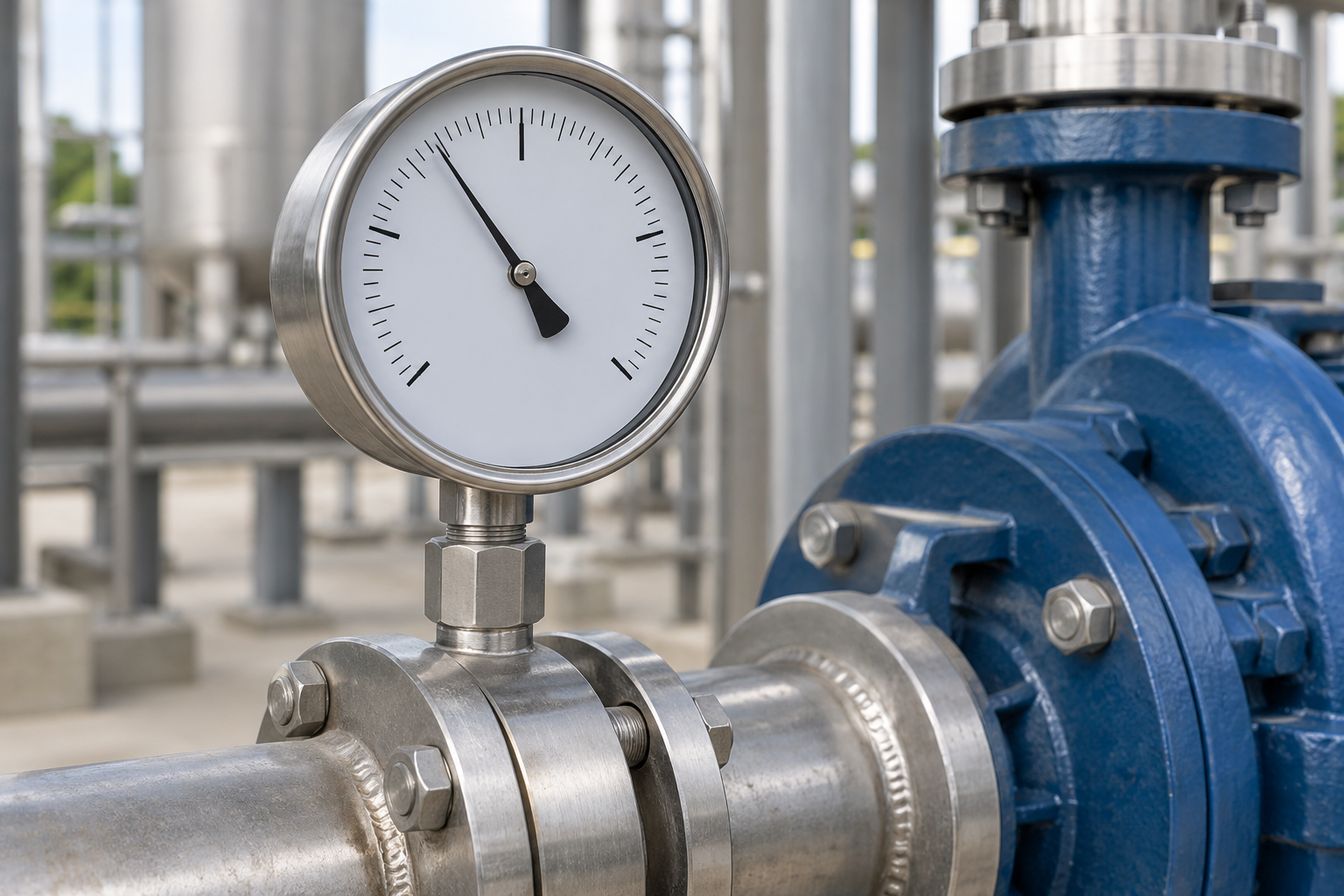
What a compound gauge reads around atmospheric zero
A compound gauge reports gauge pressure on both sides of zero. Gauge pressure uses the surrounding atmospheric pressure as its reference. A negative indication therefore means the measured pressure is below the local atmosphere; it does not mean that the system has a “negative absolute pressure.” At zero, the measured pressure equals the atmospheric reference. Zero on a compound gauge is not the zero of absolute pressure.
Three pressure references are easy to confuse:
| Pressure reference | What it compares | How to read the result |
|---|---|---|
| Gauge pressure | The measured pressure and local atmospheric pressure | May be above or below atmospheric zero |
| Absolute pressure | The measured pressure and absolute vacuum | Shows the remaining pressure from an absolute-vacuum reference |
| Differential pressure | The pressures at two ports | Shows the difference between those two points |
This distinction determines whether a compound gauge answers the actual question. If the task is to follow pressure as it crosses atmospheric zero, the compound scale can show both conditions at the same connection. If the task is to know the remaining absolute pressure in a high-vacuum system, a dedicated absolute vacuum gauge is usually the more suitable reference. If the system remains below atmosphere and only the vacuum condition needs to be observed, a vacuum gauge may be a better fit.
The instrument name alone is not enough. Check the dial or model information to confirm which pressure reference and range it uses. A reading that looks small or negative can be interpreted incorrectly if the reference is overlooked.
When a pump suction reading crosses zero
Pressure at a pump suction point does not have to stay on one side of atmospheric zero. Depending on the operating condition, the suction pressure may be positive, or it may become negative gauge pressure in a suction-lift arrangement. A compound gauge can display either state on the same dial, so the operator can follow a change through zero without changing the pressure reference mid-reading.
That does not make the gauge a complete pump diagnostic. A negative indication by itself cannot establish pump performance or confirm cavitation. Those judgments require other information, including absolute pressure, liquid level, and the liquid’s vapor pressure. The compound gauge supplies one pressure reading; it does not replace the other conditions needed to interpret the process.
If the system always operates below atmosphere, consider whether both sides of the compound scale are actually needed. When only suction or vacuum needs to be observed, a vacuum-only instrument may provide a more direct scale for that task. The choice should follow the pressure states that must be read, not just the fact that a pump is present.
How to choose the compound range
Start with the lowest expected gauge pressure and the highest expected gauge pressure at the measuring point. The vacuum end must cover the maximum expected vacuum, and the positive end must cover the maximum expected positive pressure. Confirm that the model explicitly identifies a vacuum or compound range and meets the required vacuum tolerance. A positive-pressure range printed on a standard gauge is not evidence that its sensing element is suitable for vacuum.
Then check where the normal operating readings fall on the dial. A range can technically include both extremes yet leave the pressure region that matters crowded into a small part of the scale. If the positive-pressure upper limit is set much higher than the process needs, the vacuum side can be compressed and its graduations harder to distinguish. The same issue can arise when a wide combined span is chosen without considering the useful reading area on either side of zero.
Resolution and accuracy are separate considerations. A dial with finer visible divisions can make smaller changes easier to distinguish, but that alone does not establish the instrument’s accuracy. Match the measurement need to the stated range and performance information rather than treating the number of scale marks as a substitute for accuracy.
For low-pressure gases or applications where very small vacuum changes matter, a compound gauge may not be the most readable option. The available alternatives may include bellows, diaphragm, or other dedicated low-range elements. In that evaluation, consider zero stability, resolution, installation direction, and overpressure capability. These factors matter because an instrument that spans a broad vacuum-to-positive range may not provide the same focus on a small operating band.
Why pressure units and local atmosphere matter
A unit and a pressure reference are different things. Negative kPa gauge, inHg vacuum, and Torr absolute may describe pressure using different references. Converting the unit label alone does not make those values directly interchangeable. Before comparing readings, identify whether each value is gauge, vacuum, or absolute pressure, then make sure the units are consistent.
To convert gauge pressure to absolute pressure, use the absolute atmospheric pressure at the same location and time, with both values expressed in matching units. The atmospheric reference is not a universal fixed value for every measurement. Mechanical vacuum-gauge readings are affected by local atmospheric pressure, so comparisons across different elevations or weather conditions should take that reference into account.
This is especially important when a record or specification contains only a number and a unit. Without the reference, a negative gauge reading and an absolute-pressure value can appear to describe similar conditions even though they answer different questions. Keep the pressure reference attached to the reading when it is recorded or compared.
What a full-range check should cover
The zero check depends on the pressure reference. A gauge-pressure compound gauge is generally checked at zero with its pressure connection open to atmosphere. An absolute vacuum gauge does not reach its absolute zero simply by being exposed to atmosphere. The calibration or verification method should therefore state clearly whether the reference is gauge pressure or absolute vacuum pressure.
For a compound gauge, a positive-side check alone leaves the vacuum side unverified. The check should cover the vacuum region, the atmospheric zero crossing, and the positive-pressure region used by the process. It should also observe readings while pressure moves upward through the range and as it returns, since return difference, repeatability, and the zero position are all part of how the indication behaves.
Pay particular attention after positive overpressure. A compound gauge may continue to show a plausible positive-pressure reading while its vacuum side has developed a zero offset, greater return difference, or a sticking pointer. Operation on one side does not prove that the other side remains in alignment.
A compound gauge is most useful when the measurement really needs to span both sides of atmospheric pressure at one connection. Confirm the pressure reference, both ends of the required range, vacuum suitability, and the portion of the scale where normal readings will sit. Those checks keep “one gauge covers both sides” from being mistaken for “one gauge suits every pressure task.”