 Dypressuregauge

A Vacuum Gauge Is Used To Measure Negative Pressure
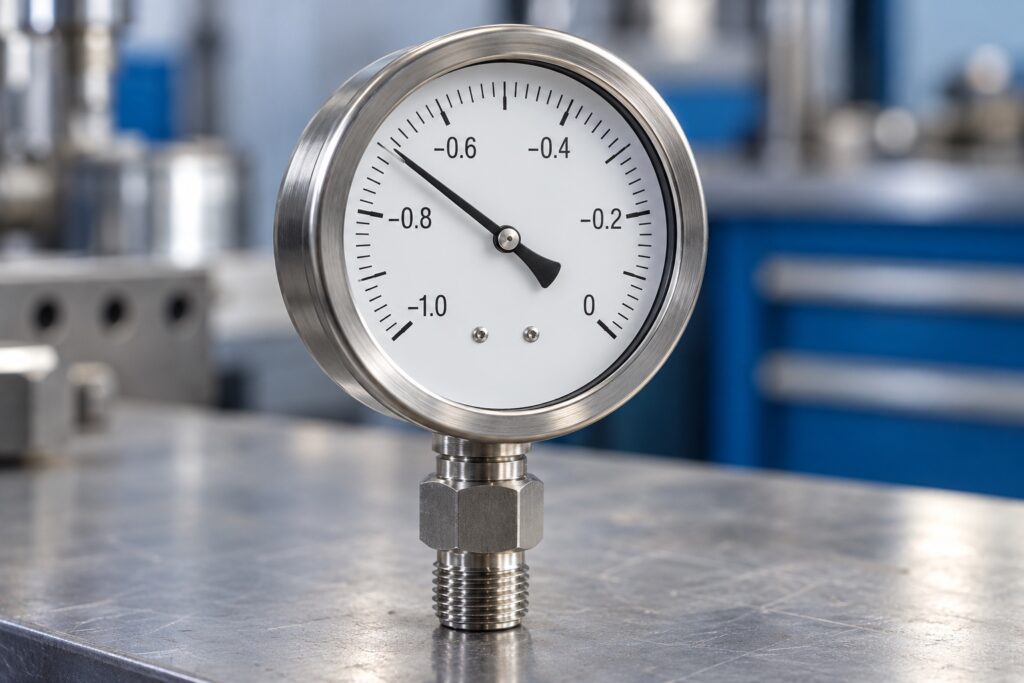
Don’t mistake the “negative value” on a vacuum gauge for absolute vacuum: Let’s clarify what negative pressure really is.
Many people get confused when reading a vacuum gauge: the needle has dropped all the way to zero—does that mean the pressure in the pipe has become negative? In fact, that’s not the case at all. The absolute pressure of the fluid in the pipe remains positive; the “negative” reading on the vacuum gauge is, simply put, a relative pressure—that is, how much lower it is than the surrounding atmospheric pressure.
On a standard gauge pressure dial, when the pointer points to “0,” it means that the pressure inside the equipment is exactly equal to the atmospheric pressure outside. Turning negative simply indicates that it is in a “negative pressure” state. The pressure-sensing element inside always measures the “difference” between the internal and external environments of the device.
This brings up a very practical issue: the atmospheric pressure around you is not constant. Both altitude and weather conditions can affect the local atmospheric pressure. Therefore, the actual absolute pressure of a vacuum you recorded in Tibet is completely different from the same number recorded at the seaside. When recording vacuum data in the future, don’t write “negative number” bare. It is better to write clearly the unit, sign and reference benchmark, otherwise there is no way to compare it in another place.
Vacuum Table Should Be Used In What? What Is Composite Table?
If your equipment (such as the inlet of the pump) has been in a negative pressure state, it is quite appropriate to use an ordinary vacuum gauge, so that you can observe whether the suction is normal at any time. But one thing you have to know: the watch can only tell you “what is the pressure at this point now”. If the suction becomes smaller, the watch itself does not know why-the liquid level has changed, the pipe is blocked, the valve is not open, or there is a leak, all of which have to be checked by yourself.
If your equipment will encounter both negative pressure and positive pressure when it is started and stopped, then the ordinary vacuum gauge will not be able to withstand it. At this time, you have to replace it with a composite pressure gauge (linkage gauge). The scale of this kind of table crosses the “0” point, which can measure both positive pressure and negative pressure. However, don’t be too greedy when choosing the measuring range. If the measuring range of the positive pressure half is too large, you can’t see the slight change in the negative pressure 1.
Don’t Make Do With The Watch. Just Because You Look Like It Doesn’t Mean You Can Use It.
Choose a watch instead of just taking one and installing it, you have to combine it with the process requirements. What is the working range? Is there any positive pressure impact? What medium is walking in the pipe? How high is the temperature? Is the thread right?
The most taboo point: don’t look at the ordinary positive pressure gauge looks similar to the vacuum gauge, just take it to measure the vacuum. Their internal structure and sealing requirements are completely different. Even if they are all measuring negative pressure, shockproof gauge and bellows pressure gauge for low pressure gas, they are aimed at completely different working conditions. You have to choose the most intuitive reading according to your normal operating pressure.
The Pointer Hit To The End = Vacuum Qualified? Don’t Be Fooled.
This is where the site is particularly prone to stepping on the pit. Sometimes when the pointer of the vacuum gauge is almost hitting to the end, the operator feels that the “deep vacuum” has been pumped in place.
Completely wrong. Ordinary mechanical vacuum gauge scale is very thick, and is to take atmospheric pressure as a reference. If you are doing the kind of evacuation operation that requires extremely high vacuum degree, you must honestly use a special absolute pressure gauge. It is purely a fool to take an ordinary mechanical watch as the acceptance standard.
Don’t Panic If The Reading Is Wrong, Follow This Routine.
If the vacuum gauge reading suddenly becomes strange, don’t rush to say that the equipment is broken.
First look at the installation: is the joint connected correctly? Are all the valves that should be opened open?
Check the meter needle: remove the meter or let it breathe to see if the pointer can return to zero. If it doesn’t return to zero, it means either the watch is broken or the inside is holding its breath.
Check the pipeline: if the vacuum degree fluctuates during operation, stroke the pipe joints, valves and hoses 1. Most of the time, the hose is sucked out and the real pressure is directly “shielded.
All in all, a useful vacuum reading is definitely more than a negative number. It is a combination of the reference point, measuring point position, the appropriate range and the current working conditions of a comprehensive result. After finding out these doorways, the vacuum meter is the sharp weapon for you to monitor the equipment, not a “metaphysical meter” that makes people confused “.