 Dypressuregauge
Atmospheric vs Gauge Pressure: The Core Differences
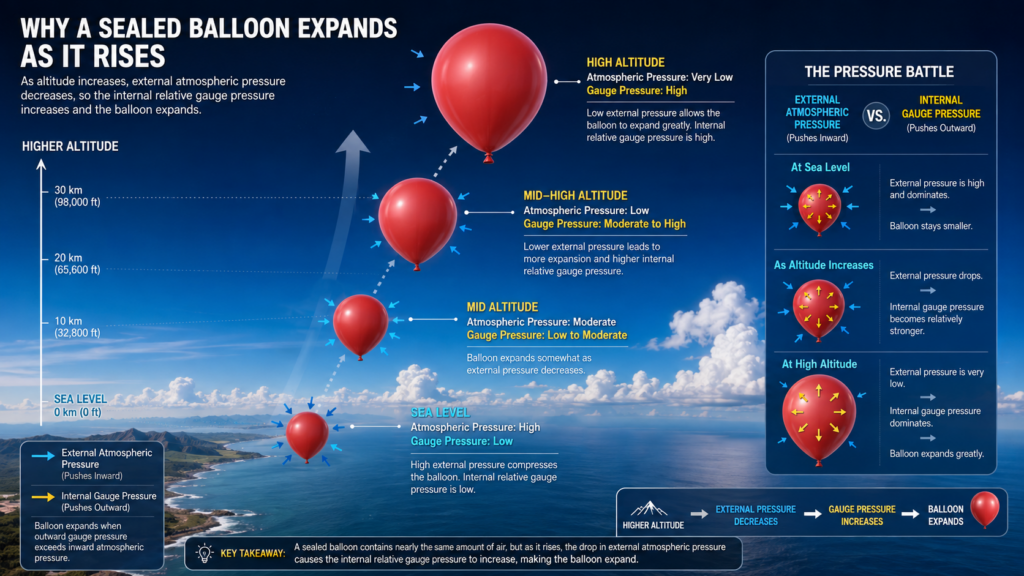
Atmospheric pressure, to put it bluntly, is the actual physical weight of the air column above the earth pressing on the surface of an object. It will constantly change with altitude and weather. The gauge pressure (Gauge pressure) measures the mechanical stress inside a closed system relative to the surrounding air. Whether you can fully understand the difference between the two concepts directly determines whether a HVAC master can add the refrigerant to the commercial chiller or accidentally give the compressor to dry waste. Engineers who do not calculate the difference between gauge pressure and atmospheric pressure often misjudge pipeline leaks when storms come, and even choose the wrong meters when doing high-altitude projects. Next, let’s break apart and talk about the physical forces behind this, the “weather trap” that destroys hydraulic testing, and the “Z.E.N.” rule used by senior fluid mechanics experts to understand pressure dynamics.
The Z.E.N. Rule: The Hard-Core Mechanisms Behind Teardown
The shortcut for engineering students and instrumentation technicians to understand fluid dynamics is to apply the Z.E.N.(Zero-point, environmental Environment, marking Notation) law. To figure out how the sensor interacts with the physical world around it, you have to understand these 3 parameters.
Zero-Point: Absolute Vacuum And Local Reference Line
Atmospheric pressure takes “absolute vacuum” as its absolute zero point. At sea level, air molecules produce about 14.7 pounds of force per square inch, because they are 14.7 PSI higher than a true vacuum. But the gauge pressure is not the same, it takes the local atmospheric pressure as the artificial zero point. When you hold a pressure gauge without any pipe in your hand, the pointer points steadily at 0 PSI, completely “ignoring” the 14.7 PSI air weight on the internal Bourdon tube (Bourdon tube).
Environment (Environment): Impact Of Weather Fluctuations
Atmospheric pressure is not a dead number, it will fluctuate up and down with thermal weather systems and geographic elevations. Hurricane transits will cause the atmospheric pressure to fall off the cliff, while mountain climbing will reduce the weight of the air column. In open-air systems, the gauge pressure subtly counteracts these atmospheric changes through mechanical structures. Since weather changes exert the same thrust on the outside of the pipeline and the internal mechanism of the pressure gauge, what is displayed on the dial is purely the physical pressure difference created by your pump or compressor.
| Metric | Atmospheric Pressure | Gauge Pressure |
| Zero Reference | Perfect Vacuum | Local Air Pressure |
| Affected by Weather | Yes | Varies by application (Mechanically cancels out changes) |
| Measuring Instrument | Barometer | Manometer/Bourdon Gauge |
| Standard Notation | PSIA/atm | PSIG |
Marking (Notation): Recognize PSIA And PSIG Labels
In order to prevent catastrophic design accidents, engineers are extremely strict with data labeling cards. The barometric pressure (and any absolute pressure measurements) must be labeled PSIA (pounds per square inch absolute) or Bar(a). The gauge pressure is indicated by PSIG (pounds per square inch gauge) or Bar(g). If the design drawing you hand in only says that you want a “50 PSI” container, but does not indicate whether the suffix is “a” or “g”, then don’t think about it, the safety audit will definitely call you back directly.
“Weather Trap” in HVAC and Hydrostatic Testing”
If you don’t take the air pressure change seriously, you can often ruin the 48-hour pipeline water pressure test. Extreme weather 1 rolled into the construction site, and the site master could easily mistake the fluctuation of the pressure gauge for system air leakage.
The “False High Pressure” Created By The Sudden Drop In Air Pressure”
In a sealed nitrogen tank, the absolute pressure of the gas is fixed. Let’s say you knocked the can down to exactly 100 PSIG on a sunny Tuesday, and as a result, 1 strong low pressure storm came up on Wednesday, and the local atmosphere was depressed. At this time, because the air on the pressure gauge becomes weak, the needle will float up to the 101 PSIG. In fact, there is no new gas in the jar at all. It is purely that the environmental baseline has moved. The inexperienced technician looked 1 and immediately released the “extra” gas from the jar. This is good. The precise gas volume required by the compliance test was completely ruined. To avoid this pit is actually simple: every time you record gauge pressure, just write down the local air pressure.
Sampling Pit Record: How A $12,000 Compressor Burned Down In Denver
If you turn a blind eye to the atmospheric pressure difference when filling the refrigerant, the consequences are fatal. Last summer, at an altitude of 5280 feet in Denver, Colorado, a junior technician abruptly scrapped a brand-new, $12000 commercial HVAC compressor.
At that time, the little brother took a standard temperature and pressure (PT) comparison table specially designed for sea level to calculate the superheat of the system. He took it for granted that the local air pressure was 14.7 PSI. But in fact, the pressure in Denver is only about 12.1 PSI. This 2.6 the PSI gap, which directly deviated his gauge pressure-absolute pressure conversion result. He misread the PSIG reading and thought there was too much liquid refrigerant in the evaporator, so he waved 1 and drained 15 pounds of R-410A refrigerant from the system. The compressor, which is seriously short of refrigerant, overheats instantly, and the copper winding inside burns completely within 4 hours of starting up. In fact, as long as the atmospheric benchmark for high-altitude areas slightly adjust the PT table, this expensive equipment scrap can be avoided.
Technology Evolution in 2026: Dual Sensor Real-Time Compensation
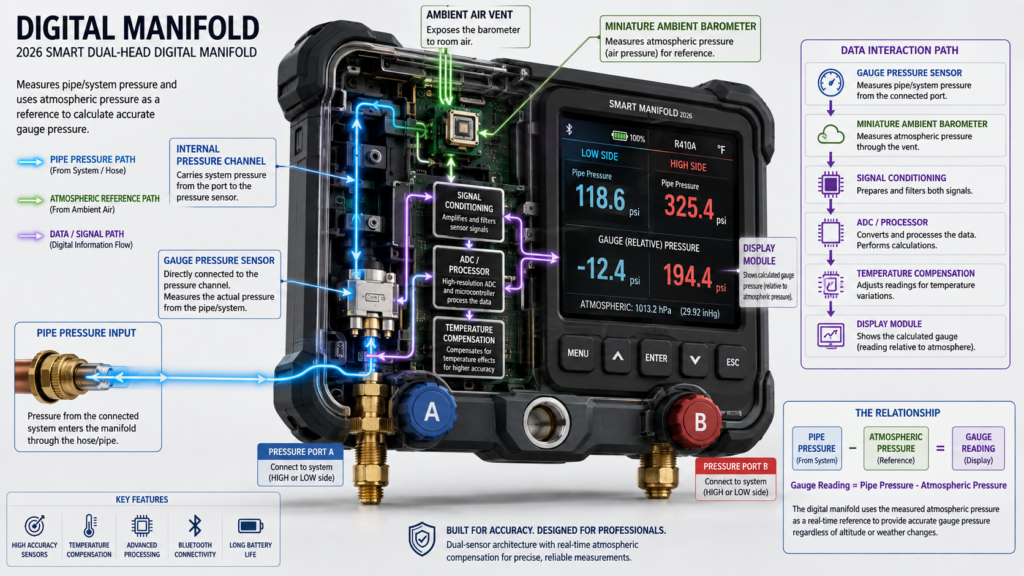
Looking at the industrial tool market in 2026, due to the general integration of dual-sensor architecture in field instruments, the masters have basically bid farewell to the bitter days of calculating atmospheric pressure by hand.
In the past, with old-fashioned mechanical watches, technicians had to check the weather APP with their mobile phones, calculate the air pressure, and then use the gauge pressure to add and subtract manually. The current 2026 digital fluoride meters (such as Detu Testo or Fieldpiece’s latest intelligent center) are much smarter: the main gauge pressure sensor is connected to the refrigerant tube, and a miniature barometer directly exposed to the ambient air is also equipped next to it. The built-in microprocessor can sample atmospheric pressure data 10 times a second, and instantly add dynamic compensation to the gauge pressure reading. With this black technology, whether you are working in a deep mountain area or in a pressurized clean room, you can calculate absolutely perfect steam pressure data without touching a calculator.
Frequently Asked Questions (FAQ)
What Exactly Is The Difference Between Atmospheric Pressure And Gauge Pressure?
Atmospheric pressure represents the weight of the air surrounding us and is measured from a complete vacuum (absolute zero). The gauge pressure is the relative difference between the pressure in a closed system and the local atmospheric pressure. So, if you open the gauge to the air, the reading is zero.
Can Gauge Pressure Be Negative?
Yes. A negative gauge pressure means that a vacuum is created relative to the surrounding environment. For example, if you dry the air in a plastic bottle, the pressure in the bottle will drop below the external atmospheric pressure, and the gauge pressure reading will be negative (for example, -5 PSIG).
Is Atmospheric Pressure Negative?
Impossible. Atmospheric pressure measures the force of solid gas molecules hitting the surface, and the number of molecules cannot be less than zero. The perfect vacuum is 0 PSIA, which is also the absolute physical bottom line on the entire pressure scale.
How To Calculate Absolute Pressure With Gauge Pressure And Atmospheric Pressure?
Just add the gauge pressure to the current local atmospheric pressure. Standard formula: absolute pressure = gauge pressure atmospheric pressure.
Why Do Engineers Look At Gauge Pressure, Not Atmospheric Pressure, When Calculating Pipes?
Because the outer wall of the pipe and the container are always hard against the extrusion of the atmosphere. What engineers really care about is the pressure difference-the internal force that wants to hold the pipe to burst, minus the external force that helps to hold the pipe. And the gauge pressure can be in place in one step, giving this pressure difference directly.
Does Atmospheric Pressure Affect Blood Pressure Readings?
There will be indirect effects. A blood pressure monitor (Sphygmomanometers) actually measures the pressure in your body relative to the gauge pressure of the room you are in. Because your body itself is naturally balanced with the local air pressure, the medical cuff measures purely that extra mechanical pumping force generated by your heart beating.