 Dypressuregauge
Difference Between Absolute and Gauge Pressure Explained
What is the absolute pressure and what is the gauge pressure? In the final analysis, the fundamental difference between the two lies only in where the “zero point” is set.
The gauge pressure (PSIG) takes the local changing atmospheric pressure as the reference zero point. To put it bluntly, it directly ignores the weight of the 14.7 PSI in the air around the instrument. In contrast, absolute pressure (PSIA) is much more real, with pure vacuum as the true zero point. This means that it not only measures the pressure inside the system, but also counts the heavy “air pressure blanket” on which the outer atmosphere is laminated.
When purchasing equipment, if engineers can’t distinguish between absolute pressure and gauge pressure (k492), it will lead to catastrophic disaster. To give the most straightforward example: if you choose a gauge pressure transmitter for a closed storage tank to be transported to high altitude areas, its safety valve will be 100% burst. Next, let’s take a good look at the mechanical principles, altitude traps and the “Z.E.R.O.” rule that senior fluid engineers are staring at when selecting models.
The Essential Difference Between Mechanical Principles
To know how the pressure gauge works, you have to look at what is in its reference chamber. Manufacturers in the manufacture of these two pressure gauges, the use of the fundamental is two sets of different mechanical structure.
gauge pressure (PSIG): directly ignore the weather
The reference chamber of the gauge pressure instrument is open and directly communicates with the surrounding air. The external atmospheric pressure pushes against the back of the sensing element (such as a Bouton tube or diaphragm), while the process fluid pushes against its front. What this watch reads is purely the difference between the two forces. If you take this watch down and throw it on the workbench, it will definitely point to zero. Industrial equipment such as air compressors, water pipes and hydraulic pipelines all use gauge pressure. After all, the influence of the external atmosphere on the whole open system is even.
Absolute pressure (PSIA): starting from pure vacuum
When the absolute pressure meter leaves the factory, the reference chamber is sealed into a high vacuum. The outside air does not touch the back of the sensing element at all. At sea level, if you put an absolute pressure gauge on the table without a tube, the pointer will actually point to the position of the 14.7 PSIA(1.01 Bar), because it measures the actual weight of the earth’s atmospheric layer on the sensor. In case of working conditions that must not be disturbed by atmospheric pressure, such as closed-loop systems, deep vacuum pumps or weather stations, engineers must only recognize absolute pressure sensors.
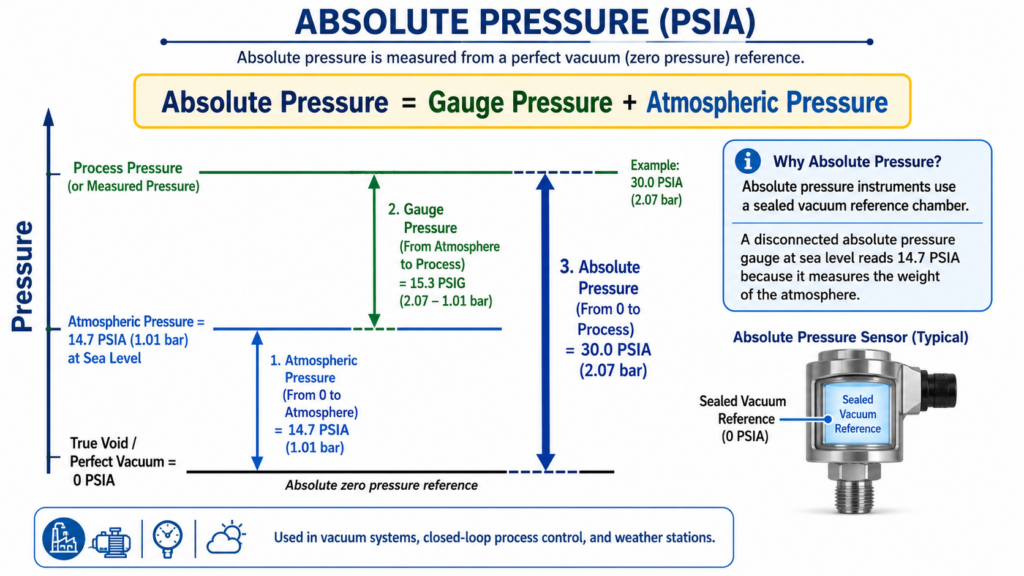
Engineer’s “Z.E.R.O.” Selection Matrix
The procurement team can avoid those costly selection pits by applying the “Z.E.R.O. Selection Matrix” to each project. As long as the following four environmental and mechanical indicators are verified before signing the purchase order, the equipment will definitely be selected well.
Z-Zero Reference Verification (Zero-Reference Validation)
Carefully 1 the physical requirements of your set of process circuits. If the system is operating below atmospheric pressure (vacuum), you have no choice but to use an absolute pressure gauge. If you have to use an ordinary gauge pressure meter to measure the vacuum line or gas extraction line, once the pressure falls below zero, the reading will become extremely outrageous.
E-Environmental volatility (Environment Volatility)
Find out the weather rules around the plant. Severe weather changes (such as when a thunderstorm is approaching) can cause local air pressure to fluctuate up and down 0.5 PSI. The gauge pressure transmitter will “convulse” with the weather and give you false data. If you are engaged in high-precision gas mixing or chemical dosing, you must choose an absolute pressure transmitter to keep external tianqi111 interference out of the door.
R-Reading accuracy requirements (Readout Precision Demand)
You have to figure out exactly what kind of data to remember. If you just want to know whether the pipe will be burst by internal pressure (relative to the surrounding air), gauge pressure is enough. But if you want to calculate gas density, mass flow, or do thermodynamic analysis, you must use absolute pressure. Because the ideal gas equation of state (PV = nRT) is unselfish, absolute pressure values must be applied to calculate the exact molecular concentration.
O-Operating Altitude Change (Operating Altitude Variance)
Find out where the equipment is going to end up. An airtight tank filled to 10 PSIG in Miami (at sea level) would have a dramatic pressure spike if pulled to Denver (5280 feet above sea level). The air in Denver is so thin that you can’t hold the walls of the tank. If your equipment is to run back and forth at different altitudes, in order to prevent accidental overpressure, absolute pressure must be used to delineate the safety red line.
Z.E.R.O. Decision Reference Table
| Application | Environment | Required Type | Relevant Z.E.R.O. Principle |
| Air Compressor | Open | Gauge | R – Readout Precision Demand (Checking burst pressure relative to surrounding air) |
| Weather Station | Open | Absolute | E – Environment Volatility (Monitoring severe weather and barometric fluctuations) |
| Vacuum Pump | Closed | Absolute | Z – Zero-Reference Validation (Operating below atmospheric pressure / vacuum) |
| Submarine | Closed | Absolute | O – Operating Altitude Variance (Navigating continuous depth/pressure changes to prevent overpressure) |
Real Case On The Scene: That $45000 Leak Over The Rockies
In November last year, 1 ordinary cargo flights had the 1 hazardous chemical spill with a loss of up to $45000. The reason was that the altitude change was not taken into account. At that time, in Houston, a young logistics engineer selected a common gauge pressure relief valve for a sealed chemical transportation ton barrel and set the relief pressure at 15 PSIG.
The ground crew loaded the ton barrel onto a 1 unpressurized cargo plane. As the plane keeps climbing over the Rocky Mountains, the atmospheric pressure outside plunges in a straight line. At this time, the chemical liquid in the ton barrel still maintains the original absolute pressure. Because the strength of the outside air pressing the safety valve becomes smaller at high altitude, the strength of the liquid inside directly rushes away the spring mechanism based on the gauge pressure. When the plane reached 20,000 feet, the safety valves burst and corrosive acid dripped 1 the entire cargo hold. If the original even upgrade to absolute pressure safety valve, you can completely eliminate this “altitude blind zone”, no matter what the weather outside, the seal ring can be as stable as Mount Tai.
Industry Trends In 2026: Ultra-High Vacuum Chambers In Semiconductor Plants
By 2026, semiconductor manufacturing will charge for nodes below 2 nanometers, which will lead to the complete reduction of gauge pressure instruments to copper and iron in extreme ultraviolet (EUV) lithography clean rooms.
EUV beams encounter air molecules that are instantly absorbed. Therefore, the chip factory must pump the lithography cavity into an ultra-high vacuum (close to 10 to Torr) in order for the laser to hit the silicon wafer smoothly. In this extreme environment, the traditional gauge pressure sensor is directly paralyzed because there is no atmospheric pressure on the back of its diaphragm to use as a reference. Equipment designers now use high-resolution capacitive absolute pressure transmitters to monitor these ultra-high vacuums to ensure that no atmospheric interference can disrupt the etching process.
Frequently Asked Questions (What Everyone Is Asking)
What is the difference between absolute pressure and gauge pressure?
Absolute pressure is calculated from the perfect vacuum (absolute zero). The gauge pressure is calculated from the local atmospheric pressure. In the open environment, the gauge pressure reading is zero, while the absolute pressure reading at sea level is 14.7 PSI.
How do I convert gauge pressure to absolute pressure?
Just add the gauge pressure directly to the local real-time atmospheric pressure. At sea level, the formula is: absolute pressure = gauge pressure 14.7 PSI (or 1.013 Bar).
When must absolute pressure and gauge pressure be clearly separated?
As long as you are calculating gas density, managing deep vacuum systems, or designing sealing equipment to go to different altitudes, you must be clear. Calculate thermodynamics and use absolute pressure for vacuum. Conventional open pipes that carry water and air can be carried out by gauge pressure.
Why do car tires use gauge pressure instead of absolute pressure?
Because the tires have to resist the weight of the car, they rely on the internal air pressure and the external air pressure. All you really care about is how much more pressure is inside the tires than the air outside on the street, so looking at the gauge pressure is the most real thing.
Can gauge pressure be negative?
Yes. When the system is vacuumed, the pressure drops below the local atmospheric pressure. At this time, a negative number (such as -5 PSIG) will be displayed on the table pressure plate, indicating that there is a negative pressure relative to the room. But note that absolute pressure can never be negative.
Absolute pressure table to the high altitude area will become what?
If you put an absolute pressure gauge in the open air at high altitude without picking up anything, it will read less than it would at sea level. The reason is simple. The air in the high places is thin, and the physical weight on the sensor becomes lighter.