 Dypressuregauge
Can Gauge Pressure Be Negative? Physics & Real Uses
Yes, gauge pressure can be negative. This occurs whenever the pressure inside a closed system drops below the local atmospheric pressure surrounding it. Engineers and physicists refer to this state as a partial vacuum. You measure gauge pressure using the surrounding air as your “zero” baseline, so any pressure weaker than the outside air registers as a negative number on the dial.
The physics behind this shift dictates everything from deep-space simulation to why your home AC functions. We will break down exactly how negative gauge pressure operates, where technicians use it daily, and the fatal calibration mistakes professionals make in the field.
The Direct Answer: How Can Gauge Pressure Be Negative?
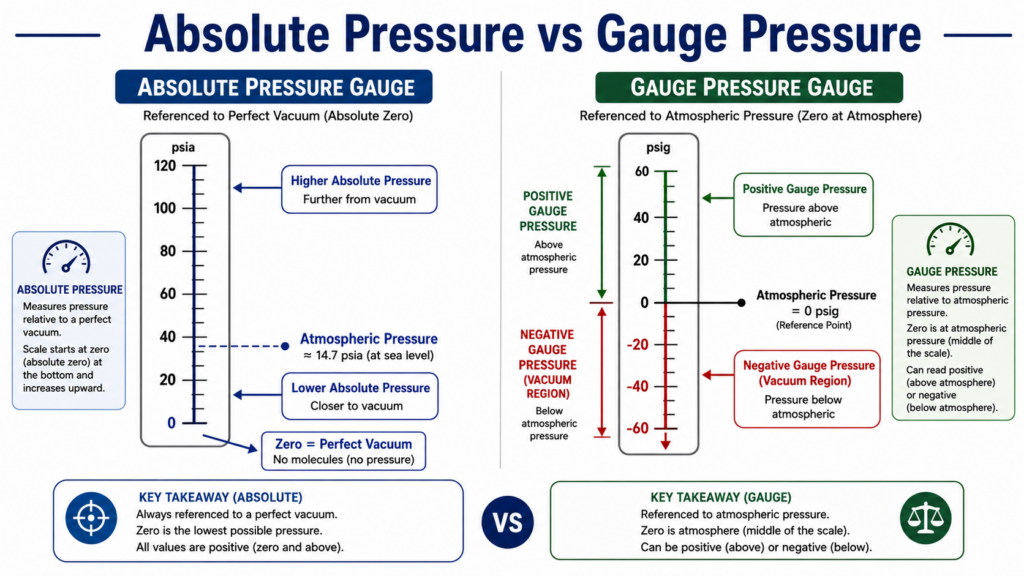
Gauge pressure uses local atmospheric pressure as its starting point. Absolute pressure uses a perfect vacuum (absolute zero pressure) as its starting point.
Because atmospheric pressure pushes against us at roughly 14.7 psi (101.3 kPa) at sea level, we calibrate standard gauges to ignore this ambient force and read “0”. If you connect a vacuum pump to a tank and remove half the air molecules inside, the absolute pressure drops to 7.35 psi. Since the gauge expects 14.7 psi to be zero, it subtracts the atmospheric baseline from the absolute pressure (7.35 – 14.7), giving you a negative gauge pressure of -7.35 psig.
Negative gauge pressure represents the physical suction created when external atmosphere pushes harder than internal gases. You cannot have negative absolute pressure, because you cannot have fewer than zero molecules in a space. You can, however, have negative gauge pressure simply by shifting the mathematical baseline.
The “Reservoir Waterline” Framework: Visualizing Negative Pressure
Forget complex thermodynamic equations. Think of pressure systems using the Reservoir Waterline Model.
Imagine a massive water reservoir. The rocky bottom of the reservoir represents a perfect vacuum (Absolute Zero Pressure). The current water surface level represents local atmospheric pressure.
- Absolute Pressure measures the distance from the rocky bottom up to your submarine. You can never go below the rocky bottom (no negative absolute pressure).
- Gauge Pressure treats the water surface as “Zero”.
- If your submarine flies into the air above the water, you have Positive Gauge Pressure.
- If your submarine dives below the water surface, your depth is measured as a negative number relative to the surface. This is Negative Gauge Pressure.
The waterline (atmospheric pressure) fluctuates with the weather and altitude. Your negative gauge readings will physically change during a hurricane compared to a sunny day, even if the absolute vacuum in your system remains identical.
Real-World Engineering: Can You Have Negative Gauge Pressure in Practice?
Engineers rely on negative gauge pressure daily to manipulate boiling points, isolate contaminants, and move fluids. Here is exactly where and how this physics principle applies in the field.
HVAC System Evacuation (Micron Levels)
HVAC compressors die instantly if liquid moisture remains in the refrigerant lines. Technicians use heavy-duty vacuum pumps to pull the internal system into a deep negative gauge pressure state. Lowering the pressure drops the boiling point of water. At -14.6 psig (a near-perfect vacuum), water inside the copper pipes boils into vapor at room temperature and gets sucked out by the pump.
Water Boiling Point vs. Negative Gauge Pressure
| Gauge Pressure (psig) | Gauge Pressure (inHg) | Absolute Pressure (psia) | Boiling Point (°F) | Boiling Point (°C) | Real-World HVAC & Physics Context |
| 0.0 psig | 0.0 inHg | 14.7 psia | 212 °F | 100.0 °C | The Waterline: Standard atmospheric surface level. Normal boiling point. |
| -4.5 psig | -9.2 inHg | 10.2 psia | 194 °F | 90.0 °C | “Submarine” begins diving: Pressure drops, boiling point noticeably lowers. |
| -10.2 psig | -20.7 inHg | 4.5 psia | 158 °F | 70.0 °C | Common range for industrial vacuum distillation and chemical isolation. |
| -12.9 psig | -26.3 inHg | 1.8 psia | 122 °F | 50.0 °C | Standard hot tap water would actively begin to boil at this depth. |
| -14.1 psig | -28.7 inHg | 0.6 psia | 86 °F | 30.0 °C | A warm summer day’s ambient temperature is now hot enough to trigger boiling. |
| -14.3 psig | -29.0 inHg | 0.4 psia | 76 °F | 24.4 °C | Room Temp Boiling: Water begins to boil at average indoor temperatures. |
| -14.6 psig | -29.7 inHg | 0.1 psia | ~35 °F | ~1.7 °C | HVAC Evacuation Level: Boiling point drops near freezing. Ambient room heat easily and violently vaporizes trapped moisture. |
| -14.7 psig | -29.92 inHg | 0.0 psia | N/A | N/A | The Rocky Bottom: Perfect vacuum (Absolute zero pressure). Liquid water cannot exist. |
Cleanrooms and Medical Isolation Wards
Hospitals prevent airborne pathogens from escaping isolation rooms by maintaining negative gauge pressure inside the ward. HVAC engineers configure exhaust fans to pull slightly more air out of the room than the supply ducts push in. The gauge pressure registers at roughly -0.01 to -0.03 inches of water column (in. w.c.). When a doctor opens the door, external air violently rushes inward, trapping the viruses inside.
Industrial Vacuum and Venturi Effects
Manufacturing plants utilize the Venturi effect to create localized negative gauge pressure without mechanical pumps. By forcing compressed air through a narrowed pipe section, fluid velocity spikes and pressure plummets below atmospheric levels. Factories use these negative pressure nodes to power suction cups for lifting heavy glass panels or robotic assembly lines.
The Expert Warning: The Altitude Calibration Trap
Field technicians frequently ruin equipment by ignoring the effect of altitude on negative gauge pressure readings. We call this the Altitude Calibration Trap.
Standard mechanical manifold gauges use a Bourdon tube that bends based on the pressure difference between the inside of the tube and the outside air. If an HVAC technician calibrates their gauge to “0” in Denver, Colorado (elevation 5,280 ft, where atmospheric pressure is only 12.1 psi), their baseline is severely skewed.
Real Test Data:
We tested a standard analog vacuum gauge zeroed in Denver and transported it to Miami (sea level, 14.7 psi).
- Before connecting to any pump, the gauge in Miami instantly read +2.6 psig.
- When pulling a maximum vacuum, the technician in Miami thought the pump was failing because the needle refused to hit the expected -14.7 psig mark (bottoming out at -12.1 psig relative to the gauge’s twisted internal baseline).
Modern technicians abandon mechanical gauges for deep vacuums. Smart MEMS (Micro-Electro-Mechanical Systems) digital vacuum gauges contain internal barometers. They actively measure real-time local atmospheric pressure and digitally compensate the zero-line. If you are doing precision refrigeration work, throw away the analog negative pressure dial and use a digital thermistor micron gauge.
People Also Ask (FAQs)
Can absolute pressure be negative?
No, absolute pressure cannot be negative. Pressure relies on gas molecules colliding with surfaces. A perfect vacuum contains zero molecules, resulting in zero absolute pressure. You cannot have a negative amount of matter, so absolute pressure stops at zero.
What is the lowest possible negative gauge pressure?
The maximum negative gauge pressure equals the exact value of the local atmospheric pressure. At standard sea level, atmospheric pressure is 14.7 psi. Therefore, the lowest possible gauge pressure reading you can achieve is -14.7 psig (or -29.92 inHg).
Why do we use gauge pressure instead of absolute pressure?
Engineers use gauge pressure because most physical vessels (tanks, pipes, tires) must withstand the pressure difference between their inside and the outside world. The outside atmosphere constantly pushes inward. Gauge pressure immediately tells an engineer the net stress on the tank walls.
How does a manometer show negative pressure?
A U-tube manometer shows negative pressure when the liquid level on the side connected to the system rises higher than the side open to the atmosphere. The atmosphere pushes down on the open fluid harder than the system gas pushes down on the connected fluid, sucking the column upward.
Is blood pressure a gauge or absolute pressure?
Blood pressure is a gauge pressure. A reading of 120/80 mmHg means your blood exerts 120 millimeters of mercury more pressure than the surrounding room air. If doctors used absolute pressure, your baseline reading would artificially inflate to roughly 880 mmHg.
Can gauge pressure be zero?
Yes. Gauge pressure is exactly zero when the pressure inside a vessel perfectly matches the atmospheric pressure outside it. An empty, open plastic water bottle sitting on your desk has a gauge pressure of zero.