 Dypressuregauge
How to Test Oil Pressure Gauge (Fix 0 or Bouncing in 2026)
To test an oil pressure gauge, disconnect the single wire attached to the oil pressure sending unit and ground it directly to the engine block; if your dashboard gauge instantly sweeps to the maximum reading, your gauge and wiring are perfectly fine. You are staring at a dead needle or a wildly erratic gauge, and you need to know immediately if your engine is self-destructing or if a simple electrical component failed. I will show you the exact bypass techniques mechanics use to pinpoint the fault without buying unnecessary parts or tearing down your engine block.
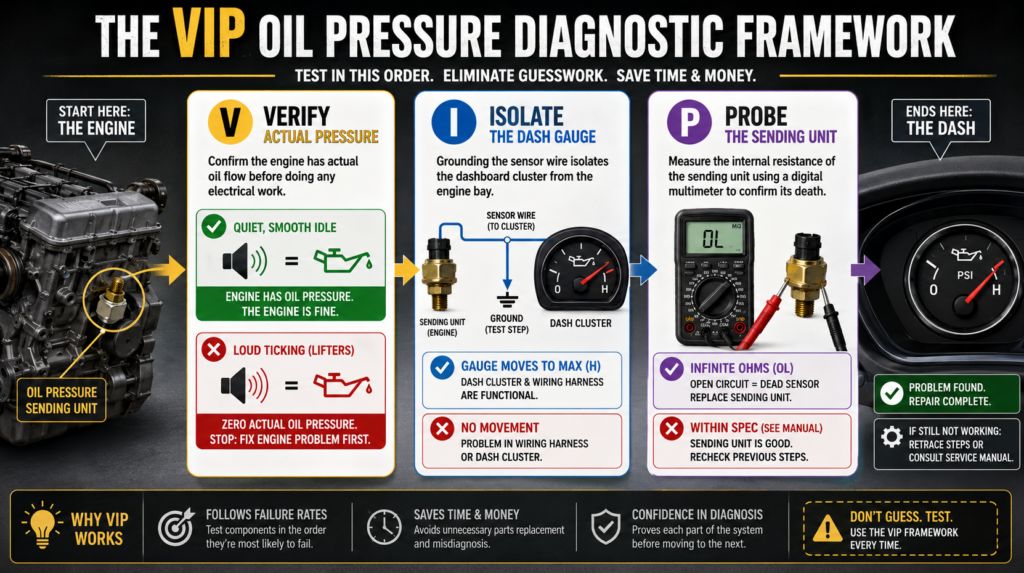
The “VIP” Oil Pressure Diagnostic Framework
The VIP framework eliminates guesswork by forcing you to test components in the exact order of their failure rates. You waste money when you guess which part is broken. Stick to this three-step process: Verify, Isolate, and Probe.
V – Verify Actual Pressure. You must confirm the engine has actual oil flow before doing any electrical work. Listen to your engine idle; a loud ticking sound from the lifters means you have zero actual oil pressure, while a quiet, smooth idle means your engine is fine and the electrical gauge system is lying to you.
I – Isolate the Dash Gauge. Grounding the sensor wire isolates the dashboard cluster from the engine bay. A gauge that moves to the maximum limit during a ground test proves the dashboard stepper motor and the wiring harness are functional.
P – Probe the Sending Unit. You measure the internal resistance of the sending unit using a digital multimeter to confirm its death. A dead sensor will show an infinite Ohms (open circuit) reading regardless of engine RPM.
Oil pressure gauge stays at 0? Do This Immediately
Turn off your engine immediately if your oil pressure gauge stays at 0 and you hear loud metallic ticking noises from the hood. A zero reading combined with valvetrain noise confirms your oil pump has failed or your oil pickup tube has fallen off into the oil pan.
You likely have a failed oil sending unit if the engine runs silently but the gauge sits flat at zero. The sending unit is a mechanical diaphragm that converts fluid pressure into an electrical resistance signal. Repeated heat cycles eventually rupture this diaphragm, causing an instant zero reading on your dash.
Testing oil pressure gauge clusters requires zero specialized tools. Unplug the harness connector from the sending unit, insert a metal paperclip into the connector terminal, and touch the other end of the clip to bare metal on the engine. Turn the ignition key to the ON position without starting the car. A gauge needle that jumps from 0 to maximum confirms you just need a $20 replacement sensor.
Oil Pressure Gauge at 0: Quick Troubleshooting Guide
| Symptom | Most Likely Cause | Immediate Action | Next Step |
|---|---|---|---|
| Gauge at 0 + Engine Ticking | Oil pump failure or oil pickup tube has fallen into the oil pan, causing loss of oil pressure | Turn off the engine immediately to prevent severe internal damage | Tow the vehicle and inspect the oil pump, pickup tube, and oil pan before restarting |
| Gauge at 0 + Silent Engine | Faulty oil pressure sending unit (internal diaphragm failure causing false zero reading) | Keep engine idling briefly and verify no unusual mechanical noise | Test the sending unit connector with a paperclip; if gauge jumps to maximum, replace the sensor |
Why is my oil pressure gauge going up and down?
A clogged sensor screen filter is the absolute most common reason why your oil pressure gauge is going up and down randomly. Dealerships routinely charge $300 to replace the sending unit on modern V8s (like the GM 5.3L LS engines), only for the customer to drive away with the exact same bouncing needle.
The tiny mesh screen filter sitting directly underneath the sending unit catches metal shavings and oil sludge. Sludge buildup restricts oil flow to the sensor diaphragm, causing sporadic pressure drops that make the dash needle bounce wildly during acceleration. Pulling the sensor out and hooking that screen with a specialized pick tool will solve the erratic reading instantly.
A chafed wiring harness will also cause your gauge to bounce erratically over bumps. The wire running from the sensor to the PCM often rubs against the hot exhaust manifold or firewall. Exposed copper briefly touching the metal chassis creates an intermittent short circuit, sending the gauge needle flying up and down in tandem with engine vibration.
Step-by-Step Guide: How to test a oil pressure gauge
Method 1: The Mechanical Gauge Bypass Test
A mechanical test kit gives you the undeniable truth about your engine’s health. You remove the factory electronic sensor and screw a physical analog gauge directly into the engine block port.
Start the engine and read the analog dial at operating temperature. A healthy engine will read roughly 10 PSI for every 1,000 RPM. A mechanical gauge showing 40 PSI while your dashboard gauge shows 10 PSI absolutely proves your electrical sending unit or dashboard stepper motor is defective.
Method 2: The Multimeter Resistance Test
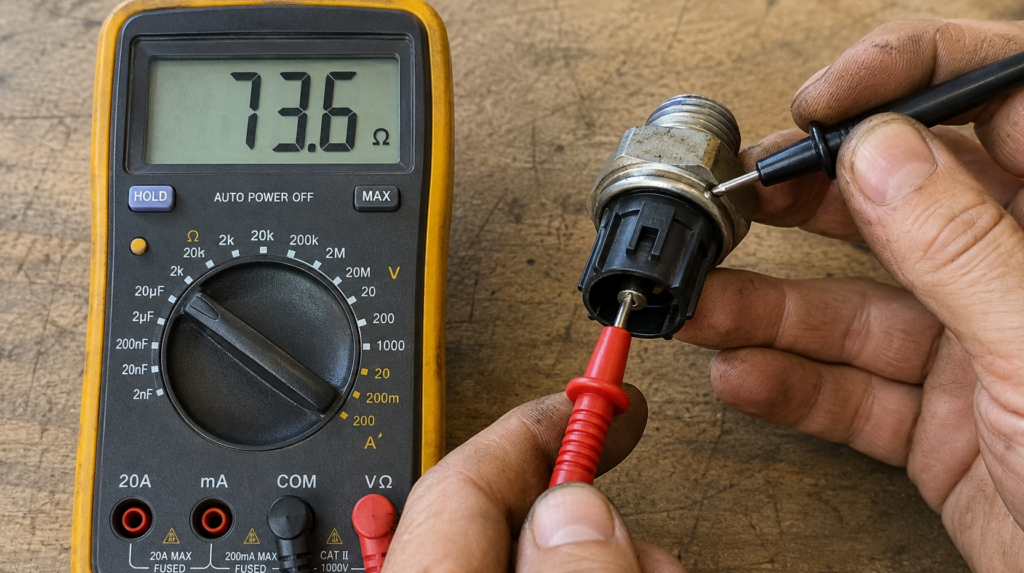
You can test the sending unit directly using a multimeter set to Ohms. Attach one multimeter probe to the metal threads of the sensor and the other probe to the electrical pin inside the connector.
The resistance must change smoothly as engine RPM increases. A reading that jumps from 20 Ohms straight to 120 Ohms, or flashes “OL” (Open Line), confirms the internal carbon track of the sensor is shattered.
“TuPian ChaRu” (Insert a close-up photo of a multimeter attached to an oil pressure sensor, clearly showing the Ohms setting and the probe placement.)
Frequently Asked Questions (People Also Ask)
Can I drive with a bouncing oil pressure gauge?
You can only drive safely if you manually verify the oil level on the dipstick is full and the engine makes no abnormal ticking noises. An erratic needle is usually an electrical glitch, but driving with a genuinely dying oil pump will destroy the engine bearings in under five minutes.
How do I know if my oil pressure sensor is bad or the oil pump?
A bad oil pump creates loud valvetrain clatter and triggers the low oil pressure warning light at low RPMs. A bad sensor typically shows completely erratic, impossible readings (like jumping from 0 to 80 PSI instantly) while the engine continues to run completely smoothly.
Where is the oil pressure sending unit located?
The sending unit screws directly into a pressurized oil gallery on the engine block. You will typically find it mounted near the oil filter housing on 4-cylinder engines, or tucked deep behind the intake manifold near the firewall on V8 engines.
Does a bad oil pressure switch affect engine performance?
A bad switch causes severe performance issues on modern vehicles equipped with Variable Valve Timing (VVT) or Active Fuel Management (AFM). The engine computer uses the oil pressure data to adjust valve timing; a faulty reading will force the computer into a sluggish “limp mode” to protect the engine.
How much does it cost to fix an oil pressure gauge?
Fixing the gauge costs between $20 and $50 if you replace the sending unit yourself. Rebuilding a failed dashboard instrument cluster stepper motor at a specialty electronics shop costs around $150. Replacing a mechanical oil pump requires significant engine teardown and costs between $800 and $1,200 at a repair shop.