 Dypressuregauge
Oil Pressure Gauge Install: Wire, Connect & Repair [2026]
Installing an oil pressure gauge requires mounting a pressure sensor (sender) to an engine oil port, routing the signal pathway safely through the firewall, and wiring the gauge dial to switched 12V power, a solid chassis ground, and the instrument illumination circuit. Performing this upgrade yourself protects your engine from unexpected oil pressure loss while saving hundreds of dollars in shop labor costs. However, a single loose connection, an overlooked firewall grommet, or an over-insulated thread sealant can lead to incorrect readings, electrical shorts, or severe cabin oil leaks. This detailed guide walks you through the entire process of adding, wiring, and troubleshooting your system to ensure your engine remains fully protected.
Mechanical and electrical gauges require entirely different routing techniques due to how they transmit pressure data to your dashboard. Your choice between these two types will dictate your routing path and the safety precautions you must take during installation.
Mechanical vs. Electrical Gauge Comparison
| Comparison Feature | Mechanical Gauges | Electrical Gauges |
| Connection Type | Direct Physical Line: Uses tubing (copper, nylon, or braided hose) to carry the actual fluid/gas (oil, coolant, fuel, boost) directly to the back of the gauge. | Electrical Wiring: Uses a sending unit/sensor installed at the source. The sensor converts physical pressure/temp into an electrical signal sent via wires to the gauge. |
| Cabin Risk | Higher Risk: Direct routing of high-pressure, hot, or flammable fluids into the cabin. A ruptured line can cause leaks, severe burns, or fire. (Note: Fuel pressure isolators can mitigate this risk). | Minimal to No Risk: Only low-voltage electrical wires pass through the firewall into the cabin. No dangerous fluids or gases enter the passenger compartment. |
| Installation Complexity | Moderate to High: Routing rigid or semi-rigid tubing through the firewall without kinking, pinching, or routing too close to hot engine parts requires careful planning. | Low to Moderate: Routing flexible copper wires is relatively simple. However, it requires proper sensor calibration, clean electrical ground connections, and wire crimping. |
| Accuracy Level | High & Real-Time: Offers direct mechanical feedback with instantaneous response and zero signal lag. Readings remain unaffected by the vehicle’s electrical voltage fluctuations. | High to Excellent (Model Dependent): High-quality gauges with stepper motors or digital processors are highly precise. However, cheaper models can be susceptible to voltage drops or poor ground interference. |
| Power Requirement | None: Functions completely without electrical power (power is only required if you want to connect a bulb for nighttime backlighting). | Required: Requires constant and switched 12V power sources to operate both the gauge and the sending unit/sensors. |
| Common Applications | Boost/Vacuum, mechanical oil pressure (often in race/track cars with safety isolators), or older classic vehicles. | Water temperature, oil temperature, fuel pressure, tachometer/speedometer, and modern daily-driven vehicles. |
Mechanical gauges pose a direct oil leak risk because they route highly pressurized engine oil directly into your passenger cabin through a thin nylon or copper tube. If this pressurized line kinks, cracks, or melts near the hot exhaust manifold, it will spray hot engine oil onto your interior carpet and drain your engine oil within seconds. Experienced mechanics suggest using copper tubing instead of nylon if you choose a mechanical option, as copper resists engine bay heat far better.
Electrical aftermarket systems eliminate cabin leak risks by converting oil pressure into an electrical signal at the engine block. The sender converts the hydraulic pressure into a variable electrical resistance (Ohms), which then travels safely along a low-voltage wire through your firewall to the gauge. Choosing to install an aftermarket oil pressure gauge using an electrical design is the safest and most reliable choice for daily-driven vehicles.
Choosing Your Setup: Mechanical vs. Electrical Aftermarket Gauges
Adding an aftermarket oil pressure gauge protects high-performance or aging engines from silent, catastrophic oil pump failures that standard dashboard warning lights fail to show in time . Standard dashboard dummy lights only illuminate when oil pressure drops below a critical level (typically 5-7 PSI), which is often too late to prevent engine bearing damage. An aftermarket gauge provides real-time pressure sweep readings, allowing you to spot gradual oil pressure decline before serious damage occurs.
Step 1: Mounting the Oil Pressure Gauge Sensor
Installing the oil pressure gauge sensor requires locating a pressurized oil gallery plug on your engine block or utilizing an oil filter sandwich plate adapter . Most engines have an existing factory pressure switch threaded into the block near the oil filter housing or on the cylinder head. You can thread your aftermarket sender directly into this port using the correct thread pitch adapter (typically 1/8″ NPT or metric M10/M12 equivalents).
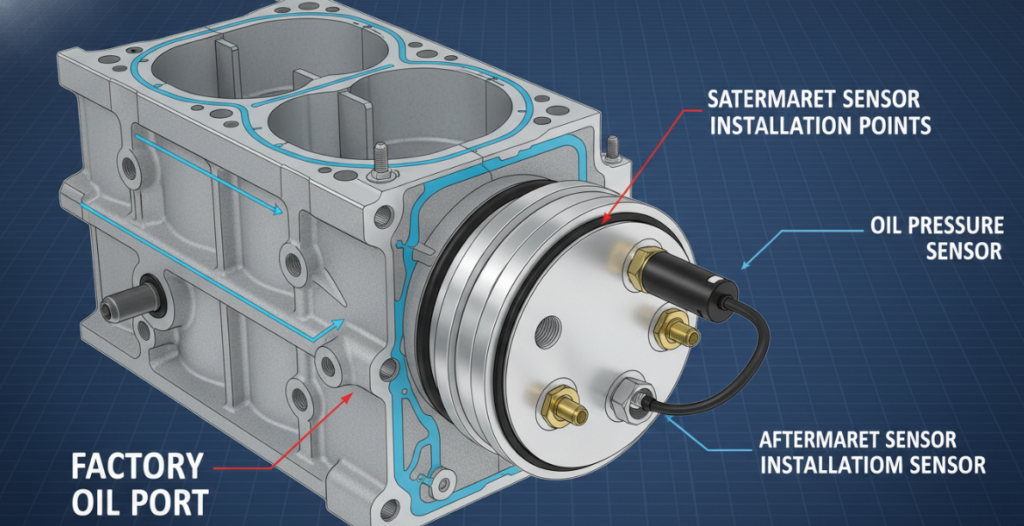
Do not wrap the entire sensor thread in Teflon tape if you are using a single-terminal sensor that relies on the engine block for electrical ground. Single-terminal sensors use their metal casing to complete the electrical circuit back to the chassis through the engine block threads. Wrapping these threads with thick Teflon tape or heavy thread sealant creates an electrical barrier, leading to a dead gauge or erratic, high-pressure readings. If you must use sealant to prevent leaks, apply a very sparse bead of liquid thread sealer to the upper threads only, leaving the first two starter threads bare to maintain clean metal-to-metal contact.
Use a high-quality brass T-fitting adapter if you need to keep your factory oil pressure dashboard light functional alongside your aftermarket gauge. A brass T-fitting allows you to thread both the factory pressure switch and the new aftermarket oil pressure gauge sensor into the single factory port. Ensure you brace the weight of this T-fitting assembly; heavy brass fittings hanging off an engine block can crack under intense engine harmonic vibrations.
Step 2: How to Wire an Oil Pressure Gauge
Connecting your aftermarket oil pressure gauge requires systematic wiring to the vehicle’s ignition power fuse, a solid chassis ground, and the instrument panel dimming circuit . Most electric aftermarket gauges feature a wiring harness with four specific color-coded leads: Red (Switched 12V), Black (Ground), White/Amber (Illumination), and Green/Yellow (Sensor Signal).
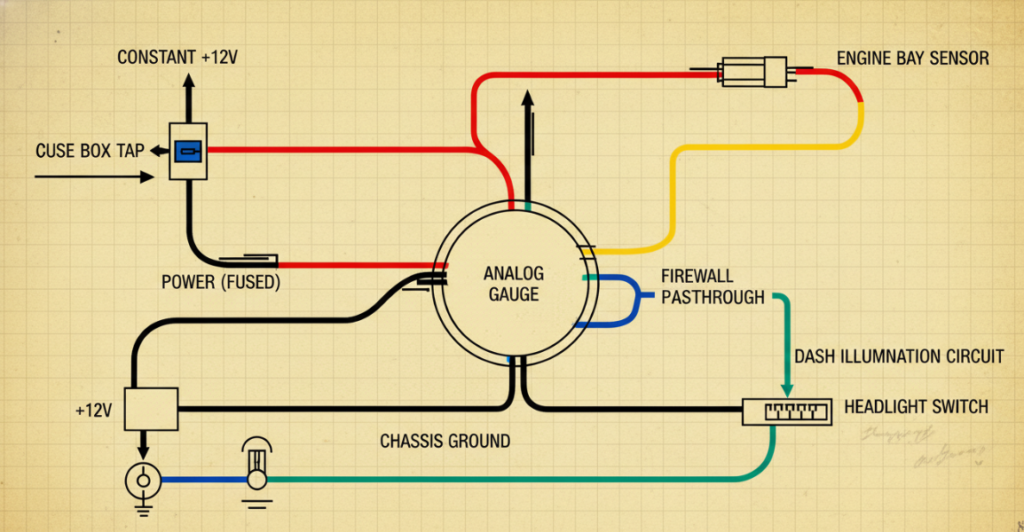
Route the sensor signal wire from the engine bay to the cabin through an existing rubber firewall grommet to protect the wire jacket from chafing on raw metal. Never run raw wires over sharp metal firewall edges or through door jambs where they can pinch and short out. Use a “Double-Sheath Firewall Routing” framework: run the wire through a high-temperature split-loom sleeve in the engine bay, pass it through a tight rubber grommet, and seal the pass-through point with automotive silicone to block engine fumes.
Connect the red power wire to a switched 12V fuse that only receives voltage when the ignition key is in the “On” or “Run” position . Connecting the gauge to a constant power source (like the battery positive terminal) will drain your vehicle’s battery overnight. Use an “add-a-circuit” fuse tap in your interior fuse panel to tap into a safe, non-critical switched circuit such as the radio or wiper fuse.
Attach the black ground wire to a clean, unpainted metal chassis bolt to prevent voltage drops that cause inaccurate readings . Avoid grounding your gauge to painted dash brackets or rusty metal screws, as bad grounding creates electrical resistance that forces the gauge pointer to fluctuate erratically. Scraping away a small patch of paint down to bare metal before tightening your ground terminal ensures a stable, noise-free circuit.
Wire the illumination lead to the factory headlight switch or fuse panel dimming circuit so the gauge dims when your headlights turn on . Tapping this wire into your parking light circuit allows the gauge backlight to transition from a bright daytime setting to a softer, non-glaring night mode. If your gauge supports multiple backlight colors, this wire connection dictates when the display switches from white (day) to amber or blue (night).
Troubleshooting and Oil Pressure Gauge Repair
A fluctuating or completely dead oil pressure gauge usually points to an electrical wiring failure or a faulty oil pressure sender rather than engine failure. Before panic sets in over a zero-pressure reading, check your oil dipstick level and listen to the engine for loud ticking noises that indicate actual low oil pressure. If the engine sounds healthy and smooth, your oil pressure gauge not working is likely an electrical issue.
Diagnose a non-working gauge by checking the signal wire voltage and testing the sender’s electrical resistance with a digital multimeter. Turn the vehicle’s key to the “On” position without starting the engine, unplug the signal wire from the sender, and touch it to a bare metal engine ground. If the gauge pointer sweeps immediately to its maximum reading, your gauge body and wiring harness are working, meaning the sensor itself has failed and requires replacement.
Instrument Gauge Troubleshooting Guide
| Symptom | Potential Root Cause | Multimeter Test / Diagnostic Step | Recommended Repair Action |
| Gauge Pegged to Max (For Standard Resistance-to-Ground systems, e.g., 240-33Ω) | 1. Sender signal wire is shorted to ground. 2. Sending unit has an internal short to ground. | Step 1: Disconnect the sender wire at the sending unit. Turn ignition key ON. – If the gauge drops to minimum, the wiring is intact; the sending unit is internally shorted. – If the gauge remains pegged, proceed to Step 2. Step 2: Disconnect the sender wire from the back of the gauge itself. – If the gauge drops to minimum, the sender wire is shorted to ground somewhere in the harness. – If the gauge remains pegged, the gauge unit itself is faulty. | – If sending unit is shorted: Replace the sending unit. – If wire is shorted: Trace the harness, repair damaged insulation/pinched spots, or run a new wire. – If gauge is faulty: Replace the gauge. |
| Gauge Pegged to Max (For Reverse Resistance systems, e.g., 0-90Ω or open-loop max) | 1. Open circuit in the sender wire. 2. Damaged or disconnected sending unit ground. | Step 1: Disconnect the sender wire at the sending unit and temporarily connect it directly to a clean chassis ground. Turn ignition ON. – If the gauge drops to minimum, the gauge and wire are functional; the sending unit is open or lacks a good ground. – If the gauge remains pegged, proceed to Step 2. Step 2: Set multimeter to DC Voltage. Measure voltage at the gauge’s “S” (Signal) terminal. If it reads 0V, there is an open loop or the gauge’s internal resistor is damaged. | – If sending unit ground is poor: Clean the sending unit threads/ground strap and ensure a solid connection. – If sending unit is open: Replace the sending unit. – If wire is open: Check for breaks, loose terminals, or corrosion along the wire path and repair. |
| No Reading at All (Gauge pointer stays flat/dead at minimum) | 1. Loss of 12V power supply to the gauge. 2. Poor or disconnected gauge ground. 3. Open circuit in the sender wire (for standard 240-33Ω systems). | Step 1 (Power Check): Set multimeter to DC Voltage. Measure voltage between the gauge “+” (Ignition) terminal and a known good chassis ground. – Expected: ~12V (or battery voltage). If 0V, power feed is lost. Step 2 (Ground Check): Set multimeter to Resistance (Ohms). Measure resistance between the gauge “-” (Ground) terminal and chassis ground. – Expected: < 1.0 Ω. If resistance is high or infinite, the ground connection is bad. Step 3 (Sender Loop Check): Temporarily jump the gauge “S” (Signal) terminal directly to the gauge “-” (Ground) terminal. – If the gauge sweeps to maximum, the gauge is functional; the issue is an open sender wire or a failed sending unit. – If the gauge does not move, the gauge mechanism is faulty. | – If power is lost: Check and replace blown fuses, verify ignition switch feed, or repair the power wire. – If ground is bad: Clean connections, tighten ground nuts, or run a new ground wire. – If sender wire is open: Repair the broken wire or clean corroded connection terminals. – If gauge is faulty: Replace the gauge. |
| Fluctuating / Erratic Pointer (Jumping or unstable readings) | 1. Loose or corroded wiring connections. 2. Intermittent ground connection. 3. Worn resistive element inside the sending unit. 4. Faulty Instrument Voltage Regulator (IVR). | Step 1 (Ground Stability): Set multimeter to Resistance (Ohms). Measure from the sender body/ground terminal to chassis ground while wiggling the wire harness. – Expected: Constant low resistance. If values jump erratically, the connection is loose. Step 2 (Sender Resistance Check): Disconnect the sender wire. Measure resistance across the sending unit terminals while gently tapping the sender or changing the fluid level/pressure (if applicable). – Expected: Smooth transition in resistance. Sharp spikes or dropouts indicate a worn sweep arm inside the sender. Step 3 (Voltage Stability): Measure voltage at the gauge “+” terminal with the engine running. – Expected: Stable voltage. If fluctuating wildly, check the alternator regulator or the cluster IVR (older vehicles). | – If connections are loose/corroded: Clean terminals, apply dielectric grease, and crimp/tighten all connectors. – If sender is worn internally: Replace the sending unit. – If voltage regulator/IVR is faulty: Replace the voltage regulator or stabilizer module. |
Repairing a faulty gauge setup involves replacing the corroded sender or replacing damaged wire runs with high-temperature automotive-grade primary wire. Over time, road salt, engine heat, and moisture corrode the sensor terminals, raising the electrical resistance and causing the gauge to display artificially low oil pressure. Clean the sensor terminals with electrical contact cleaner, or replace the entire oil pressure gauge sensor using a deep socket to restore clean, accurate readings.
Real-World Case Study: The Chevy LS High-Vibration Sensor Failure
A field study conducted on high-vibration engine swaps revealed that sensor mounting orientation directly impacts the lifespan of the pressure sending unit. In this study, single-terminal aftermarket senders mounted horizontally on the rear oil valley cover of Chevy LS engines suffered a 40% failure rate within 5,000 miles.
The intense vertical engine harmonics caused the internal diaphragm of horizontally mounted sensors to fatigue and crack, leading to oil weeping into the electrical plug. Relocating the sensor using a short braided stainless steel hose to remote-mount it to the inner fender wall completely isolated the sensor from engine vibrations. This remote-mount method extended the sensor’s lifespan indefinitely, proving that isolating delicate electrical senders from direct engine vibrations prevents premature component failure.
Frequently Asked Questions (FAQ)
Why is my oil pressure gauge not working or showing zero?
Your gauge is likely suffering from an open circuit in the signal wire or a completely dead pressure sender. Check to see if the signal wire has disconnected from the sensor terminal in the engine bay. If the wiring is secure, test the system by grounding the signal wire; if the gauge needle sweeps to the maximum value, replace the faulty sender .
How do you wire an oil pressure gauge to a switched power source?
You must connect the red power wire to a circuit that only receives 12V power when the ignition key is in the “Run” position. Locate your interior fuse box, use a multimeter to find a fuse that turns on and off with the ignition key (such as the radio or accessory socket), and install an “add-a-circuit” fuse tap to connect the gauge safely.
Can you use Teflon tape on an oil pressure gauge sensor?
You should avoid using heavy Teflon tape on single-terminal sensors because they require a metal-to-metal connection with the engine block to complete their electrical ground path. Wrapping the threads in tape insulates the sensor, which prevents the electrical signal from reaching the gauge. If you must use sealant to prevent leaks, apply a very small drop of liquid thread sealer only to the top threads, leaving the first few threads bare.
How do I connect an oil pressure gauge without removing the factory sensor?
You can use a brass T-fitting or an oil filter sandwich plate adapter to install your aftermarket sensor alongside the factory unit. A sandwich plate mounts between your oil filter and the engine block, providing multiple 1/8″ NPT ports to easily thread your aftermarket sender in without modifying any factory engine sensors.
What is the difference between mechanical and electrical oil pressure gauge repair?
Mechanical gauge repair typically involves replacing cracked nylon or copper lines that carry pressurized oil into the cabin, while electrical gauge repair involves replacing corroded wires or the sender unit itself. Electrical repairs are safer and cleaner to perform because they do not carry the risk of oil leaks inside your vehicle’s interior.