 Dypressuregauge
How To Calibrate A Metal Stem Thermometer
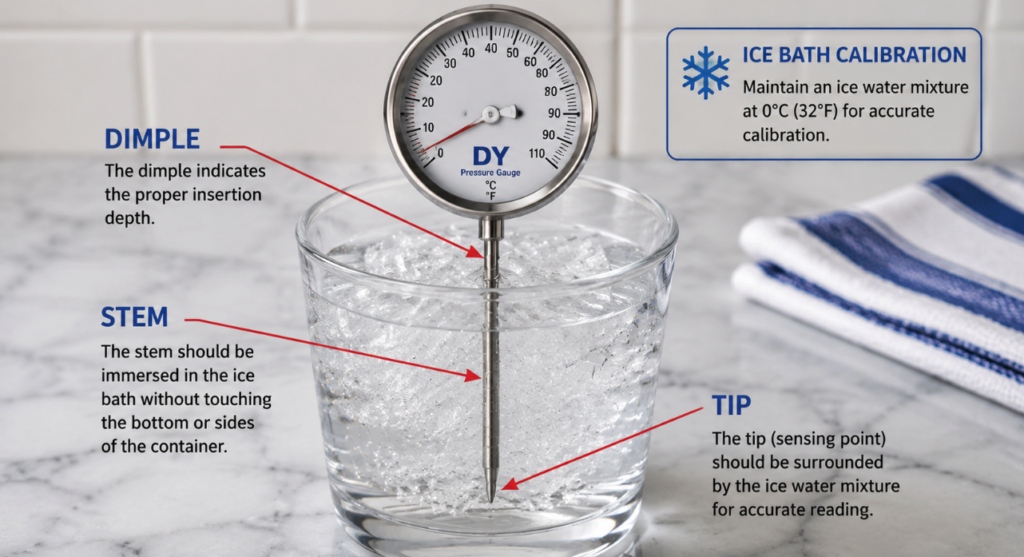
To accurately calibrate a bimetallic probe thermometer using the industry standard freezing point method, you have to fill large glass with crushed ice and then pour in distilled water to make a thick ice bath. After stirring, insert the probe of the thermometer. Note that the water level must completely cover the “dent” on the probe (that is, the temperature sensing area), and let the probe hang in the middle of the cup, never touch the cup wall or the bottom of the cup. Wait for about 30 seconds until the dial hands are dead. If the reading is not exactly 32 °F(0°C), use the wrench or the self-contained slot on the thermometer protective sleeve to jam the small hexagonal calibration nut directly below the dial. Hold the nut with one hand and gently turn the gauge of the thermometer with the other until the pointer is fully aligned with the 32 °F. If you do this, your equipment will fully meet the FDA’s food safety standards, and the error will be kept within the mandatory requirement of plus or minus 2 degrees.
Why Do You Have To Use Crushed Ice And Distilled Water?
The preparation of an ice bath is absolutely the basis for the success or failure of this method. It is definitely a pit to use large ice cubes and tap water directly in daily operation, and the reading is easy to deviate. Crushed ice must be used, because crushed ice can be pressed very firmly and will not leave a gap that hides warm water. As for adding distilled water, this is equally deadly for commercial and industrial-grade accuracy. Those heavy metals and impurities in the tap water will slightly change the freezing point of the mixture. By mixing compacted crushed ice with distilled water, you can create an absolutely uniform temperature environment and ensure that you get a true 32 °F(0°C) baseline. Remember to stir hard before inserting the thermometer, so as not to let the water have uneven temperature.
Understand The “Dent” And The Correct Insertion Technique.
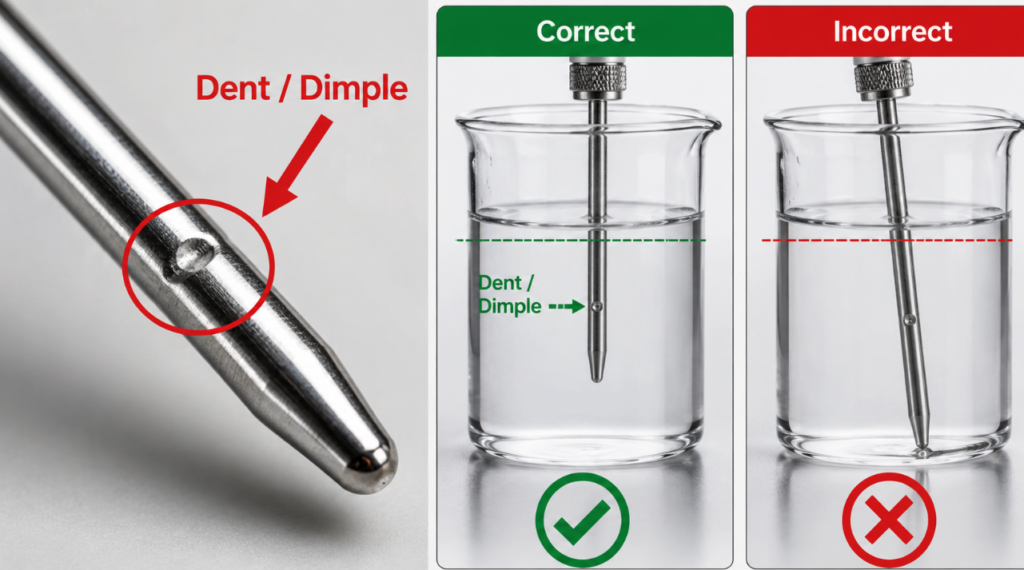
To be honest, the depth of insertion in calibrating this stuff is the most misunderstood place. There is a small pit called “dent” on the metal probe, which is actually the finish line of the internal bimetallic temperature sensing coil. If the water level does not cover this dent, the entire coil will not be able to fully contact the low temperature of 32 °F, and the final reading will definitely be too high. There is another rule that is very rigid but must be followed: the probe must be hung honestly in the center of the cup and must never touch the wall or bottom of the cup. You should know that the glass absorbs the heat of room temperature or the operating table all the time. If the probe is attached to the cup, then it measures the temperature of the cup, not ice water at all, and your calibration will be wasted directly.
The 30-Second Rule.
When dealing with mechanical temperature sensors, patience is a hard technical indicator. The bimetal probe thermometer is different from the second-reading digital probe. Its probe is welded with two different metals. The two devices expand and contract at different rates of heat and cold. This is used to toggle the pointer. After plunging into the thick ice bath, the metal coil needs enough time to physically contract to its extreme cold state. Honestly wait for about 30 seconds before the mechanical transmission of temperature can be completely completed. You’ll have to stare at the dial until the needle doesn’t move. Are you in a hurry to screw the nut before the metal has completely stabilized? Then what you have adjusted is fundamentally wrong.
Play With Calibration Nut And Sleeve Wrench
If the reading deviates from 32 °F(0°C), it will have to be mechanically adjusted by hard means. The calibration nut is the small hex nut on the probe just below the dial. Most commercial-grade thermometers are equipped with a protective sleeve, which usually has a built-in wrench structure (usually a long strip slot) specially designed to hold the nut. I strongly recommend using this stuff, don’t go through the toolbox to find ordinary vise, it is easy to twist the nut slippage, or bend the fragile probe. Calibration requires the cooperation of two hands: hand holds the sleeve and tightly clamps the hexagon nut to prevent it from moving, and the other gently rotates the thermometer head (that is, the dial shell) with the other hand. This action turns the dial abruptly, bringing it back into perfect alignment with the position of the internal bimetal coil, pulling the reference line directly back to 32 °F.
The Hell With FDA Compliance And Industrial-Grade Devices
Stuck the error within plus or minus 2 degrees is not an industry recommendation, but a mandatory regulatory requirement in the FDA’s food safety guidelines to prevent foodborne illness and cross-contamination. Every time the thermometer drops, or encounters that kind of sharp temperature change, it risks falling out of this strict compliance range.
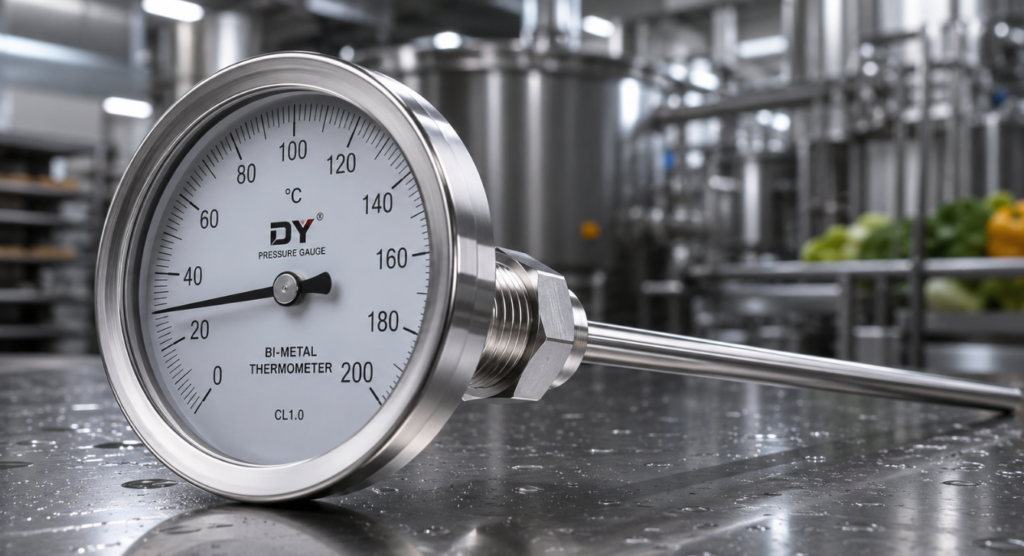
This involves a very realistic question-whether your equipment foundation will work or not. Those who work in commercial kitchens, food processing plants and industrial operations know in their hearts that a poorly made thermometer has to be adjusted from day to day, because the coils inside it quickly age. If you purchase goods directly from first-line manufacturers in the industry such as DY Pressure Gauge, the enterprise can let the people at hand use high-end bimetal probe thermometers that are resistant to construction and absolutely stable in structure. These high-quality instruments from DY Pressure Gauge use high-quality stainless steel parts and advanced coil mechanics that resist deflection, which means they can maintain calibration for much longer. To put it bluntly, if your business has to rely on absolute accuracy to meet FDA standards, spending money on top-grade thermometers can definitely cut off pile of maintenance mess and make you feel confident about the temperature measured every time.
Author:Chef Marcus Reed
Holding an advanced ServSafe Manager certification, I treat food safety not just as a rule, but as a rigid science. Throughout my career, I’ve battled with failing kitchen equipment and realized that absolute precision is the only way to avoid foodborne risks. That’s why I am passionate about sharing practical calibration techniques and strongly advocate for using industrial-grade, highly durable instruments like those from DY Pressure Gauge. I believe that investing in the right tools is the ultimate secret to a safe and successful kitchen.