 Dypressuregauge
How To Check Pressure Transmitter With Multimeter
If you want to use a digital multimeter to accurately detect a two-wire pressure transmitter, the key is to connect the meter in series into a current loop to measure its 4-20mA output signal. My usual habit is to confirm that 24V DC power supply is no problem. Next, set the multimeter to the DC milliampere range and make sure that the meter pen is inserted into the hole. Carefully remove the signal wire from the positive terminal of the transmitter. The red pen is connected to the newly removed wire, and the black pen is directly placed on the positive terminal of the transmitter, thus closing the circuit. For a normal transmitter, the reading will steadily stop between 4mA and 20mA. If the reading is stuck at 0mA, either the circuit is broken or the power is dead. If the value jumps randomly or cannot be calibrated at all, nine times out of ten the internal sensor is scrapped. At this time, just change to a reliable industrial-grade new meter.
The following set of guidelines is to disassemble the specific steps I usually take to remove obstacles and give a safety reference to the maintenance brothers on site so as not to damage the equipment.

Understand 4-20mA Output And “Series” Measurement
To check the basic skills of the two-wire transmitter is to thoroughly understand its output signal. In the industrial field, this thing communicates with PLC or DCS by 4-20mA current loop.
The voltage measurement is to measure two points across, but the current measurement is different. What you measure is the flow of electricity running in the loop. That’s why it has to be connected. The low-level mistake that many novices are prone to make is that they do not remove the stitches and directly touch the terminals with the stylus to measure the current, which directly leads to a dead short circuit. I have seen this situation too many times. The fuse in the multimeter blows out instantly, and the meter itself may even be burned.
The First Step Is Always To Confirm 24V DC Power Supply
Before you start to dismantle any wire to measure the current, eliminate the stupidest and most common cause of failure: no electricity at all. The vast majority of two-wire pressure transmitters work on a 24V DC power supply.
How to check: Don’t move the line. Put the multimeter to DC. Red pen put positive, black pen put negative.
Result Judgment: Under normal circumstances, you should be able to see a reading close to 24V DC. However, if it is measured to be 0V, there is nothing wrong with the high probability transmitter itself. Quickly check whether the fuse in the cabinet is burnt, whether the power supply is tripped, or whether the cable from the control room to the site is broken.
Multimeter Switch To DC mA Gear
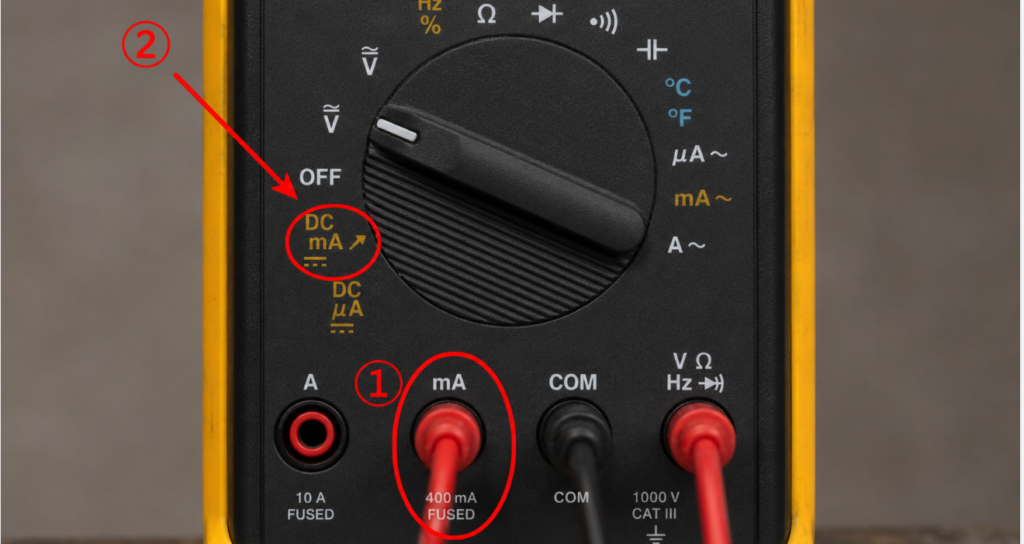
After confirming that there is 24V power supply, you can prepare to measure the current. At the moment, the physical jack and dial of the multimeter have to be moved:
Change the jack: Pull out the red probe from the usual voltage/resistance hole and insert it into the special mA hole of the multimeter.
Toggle dial: Toggle the gear from voltage to DC mA. With these two actions done, your multimeter can now be safely connected to the electrical circuit.
Disconnect And Connect In Series
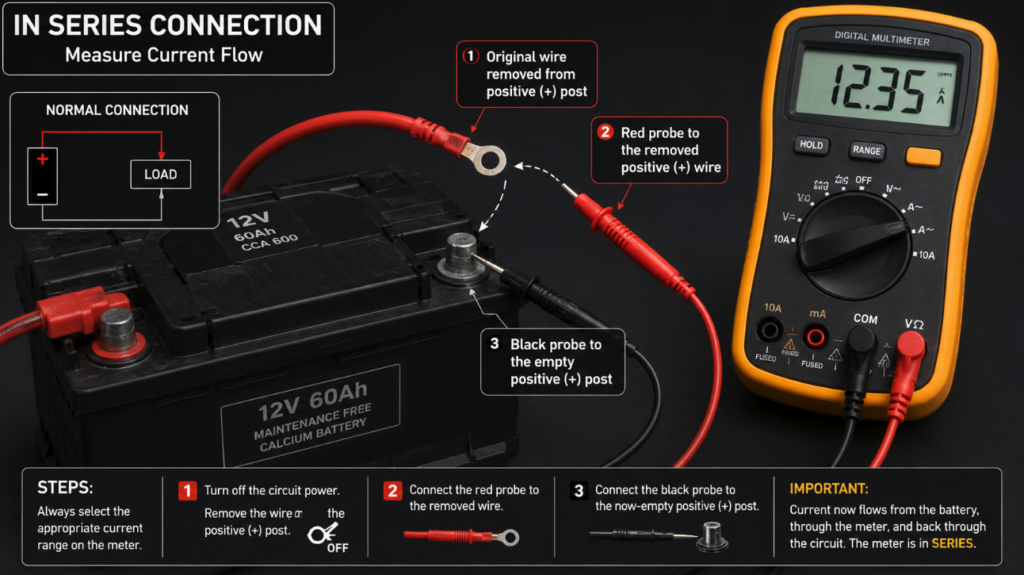
This is the most critical step. We’re going to disconnect the electrical circuit artificially, then use a multimeter as the 1 bridge and reconnect it.
Disassembly: Take the screwdriver used for the connection terminal and carefully loosen and unplug the signal line on the positive terminal of the transmitter.
Connect the red stylus: connect the red stylus of the multimeter with the bare copper wire just pulled out.
To connect the black stylus: directly press the black stylus of the multimeter on the positive terminal of the transmitter that is now empty.
In this way, the is connected, and the current comes out of the wire, flows into the multimeter, then flows into the transmitter, and finally flows back from the negative electrode. You have successfully completed the series closed loop.
How To Read: Good Watch Or Bad Watch
After the watches are connected in series steadily, look at the number on the DMM screen and you will know exactly what the transmitter is.
The reading is stable at 4mA-20mA: if there is no pressure in the pipeline, the gauge should refer to exactly 4.00 mA. As the pressure rises to the maximum range of the sensor, the current will scale up to 20.00 mA. As long as your reading matches the actual pressure on the process side, the transmitter is working properly.
Dead card at 0mA : 0mA means the loop is broken. Since it has been confirmed that there is 24V electricity, the series measurement is still 0mA. According to my experience, the circuit board inside the transmitter is basically completely scrapped.
Numerical jump: As long as the mA value jumps irregularly there, or the transmitter cannot do zero and range calibration anyway, the internal sensing diaphragm is usually broken, flooded or physically damaged.
Change To A Reliable New Industrial Watch
If the reading of the multimeter is already true, the internal sensor is dead or the circuit board is burned, continuing to unblock is a waste of valuable maintenance time. A bad transmitter on site will not only cause process shutdown, DCS monitoring blind area, but also cause safety accidents.
At this stage, the bad equipment is directly removed and replaced with a reliable industrial-grade new watch.
For equipment supervisors and maintenance engineers, choosing a solid substitute can prevent the same failure from recurring. The high-quality industrial pressure transmitter housing is resistant to construction, the protection level is extremely high, and the internal sensor is stable enough to resist strong vibration, pressure shock and harsh environment on site. An honest and trustworthy industrial product can at least ensure that you can see a steady 4-20mA signal when you take a multimeter to measure it next time.
Author:Mike Reynolds
I’ve spent countless hours troubleshooting field instruments and communicating with PLC/DCS systems. I write these practical, no-nonsense guides to share my daily experience with my fellow maintenance brothers on site. My goal is to help you avoid rookie mistakes, troubleshoot equipment safely, and keep plant processes running smoothly. When a sensor fails, I believe in diagnosing it accurately and swapping it for reliable, heavy-duty industrial gear.