 Dypressuregauge
How To Use A Fuel Pressure Gauge: Step-By-Step (2026)
To check the fuel pressure with a pressure gauge, you must first connect the tester to the fuel rail of the engine. Then, record the pressure readings under the two states of “power on but not ignition” (KOEO) and “engine running” (KOER), and finally compare these data with the data provided by the original manufacturer. After this 1 operation, if the car has difficulty starting, idling jitter, or weak acceleration, you can accurately find out the “real culprit” behind it-whether the fuel pump is about to be scrapped, the gasoline filter is blocked, or the fuel pressure The regulator has a moth. Sounds simple, right? But if the operation is wrong, high-pressure fuel spurting out is no joke, and it may cause you to spend money on the wrong accessories. Then look down, I will teach you how to safely connect the pressure gauge to various models, and I will also share the trick of an old auto repair master-you don’t need to remove any parts, you can find the leakage point of the fuel system in ten minutes.
Fuel Pressure Diagnostic Pyramid: Roots of Fuel Testing
Check the fuel system can not just stare at the single pressure at idle speed, there must be a set of system logic. We have summed up a “fuel pressure diagnosis pyramid” to help car owners who repair their cars understand whether the fuel system is healthy or not. It all depends 3 a closely connected level:
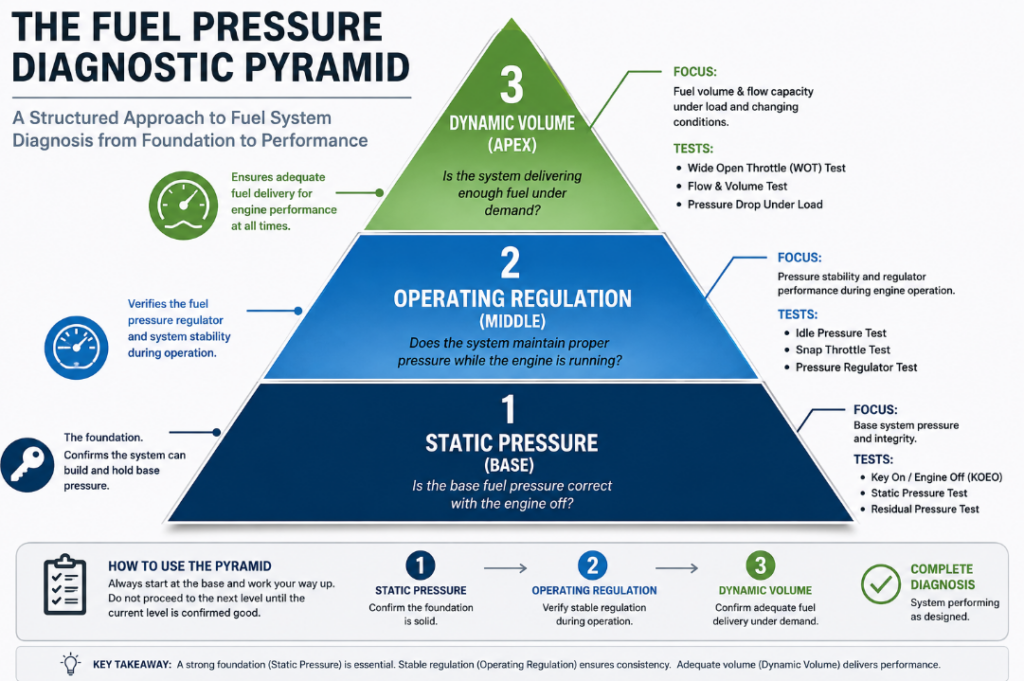
- Static pressure (bottom foundation): When the engine is turned off, the system must be able to build pressure and hold pressure so that it can be hit next time.
- Dynamic adjustment (middle level): When the engine vacuum changes, the regulator must be able to dynamically adjust the pressure to keep up with your need to step on the accelerator.
- Dynamic flow (spire): The fuel pump must be able to provide enough oil in a short time to ensure that the mixture is not too thin when the 1 foot floor oil goes down.
In this article, we mainly talk about how to use the fuel pressure gauge to get the first two levels. As long as you check step by step in sequence, you can avoid the cheat people situation that “you have to spend a lot of money to change the fuel pump blindly, which can be solved by changing the regulator or filter element.
Essential tools and safety knowledge: preparation before wiring
High-pressure gasoline can easily cause fires, so safety protection must not be sloppy before construction starts.
Why Not Ignore Fuel Pressure Safety
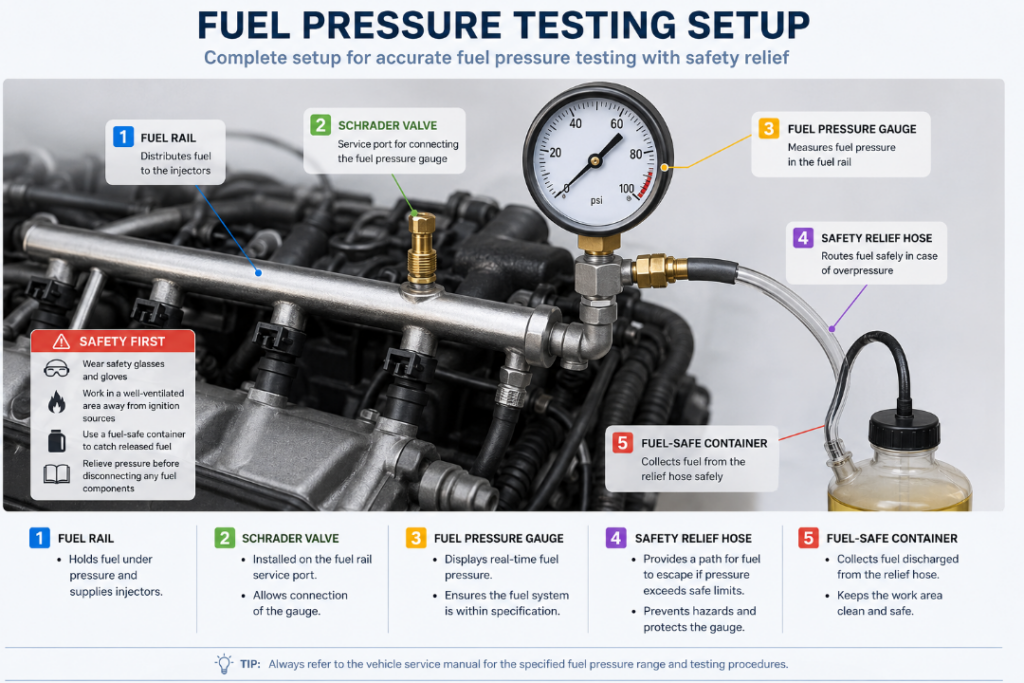
In today’s EFI cars, the gasoline pressure in the pipeline is very high, usually between 35 and 65 PSI. If the system is still under pressure and you loosen the joint directly, the gasoline will be sprayed out immediately and violently. Remember to wear oil-resistant nitrile gloves and ANSI-compliant safety goggles, and never let high-pressure gasoline spray into your eyes. A full Class B fire extinguisher must be at hand where you work. In addition, the test must be done in the cold state of the car, so as not to leak the gasoline dripping into the hot exhaust manifold directly cause a fire.
Fuel Pressure Test Kit List
A reliable fuel pressure test gauge not only reads accurately, but also does not leak oil easily at the joint. Before starting work, make sure that your kit contains all the corresponding basic connectors and components before starting operation.
| Component Name | Primary Function | Why It Matters for DIYers |
|---|---|---|
| Bourdon Tube Gauge | Displays pressure in PSI and Bar | Needs a rubber boot to protect against drops. |
| Schrader Valve Adapter | Screws directly onto standard 1/4″ test ports | The most common connection point on fuel rails. |
| Inline T-Adapter | Splices into fuel lines without test ports | Required for vehicles lacking a dedicated Schrader port. |
| Pressure Relief Valve | Safely bleeds off fuel and pressure after testing | Essential for safe, spill-free gauge disconnection. |
| Clear Discharge Hose | Channels bled-off fuel into a container | Prevents raw gasoline from pouring onto the hot engine. |
How To Connect The Fuel Pressure Gauge (With Or Without American Valve)
The fuel system design of each car is different, so you have to choose how to connect the meter according to the actual layout of your engine.
Method A: Connect the standard Schrader valve (the simplest 1)
In many American and some sub-series cars, finding the special test interface is the simplest way to use the pressure gauge.
- Locate the fuel rail above the engine, next to the fuel injectors.
- Find the Schrader valve, it looks exactly like a metal tire valve.
- Unscrew the plastic protective cap and clean the mud and dust around the thread.
- Pick out the matching connector from the kit and tighten it on the valve by hand. Make sure that the thimble inside the connector can just open the core in the middle of the valve so that gasoline can flow into the hose of the watchband.
Method B: Add series tee connector (for models without test interface)
Many modern European and Asian cars don’t have test interfaces at all, so we have to connect a three-way connector in series on the oil supply line.
- Look in the direction of the fuel tank and find the main fuel supply line that connects to the fuel rail.
- Key: Before pulling out the pipe, be sure to completely relieve the pressure to the system (see the steps below for details on how to relieve the pressure).
- Pull off the quick connector of the oil pipe. Some cars may need special removal tools.
- Plug the tee fitting between the oil supply line and the oil inlet of the guide rail and lock it with the quick-connect clip or hose clamp provided in the kit.
- Finally, connect the hose of the pressure gauge directly to the remaining port of the tee.
Hand-to-Hand Diagnostic Process: Inspection and Testing
Step by step according to the rules, not only the measured data are accurate, but also the work safety can be ensured.
Step 1: System Pressure Relief And Meter Connection
Before disassembling any joint of the fuel system, the residual pressure inside must be released, otherwise the gasoline will be sprayed everywhere, which is extremely dangerous.
- Look for the fuse or relay of the fuel pump, usually in the fuse box in the engine compartment.
- With the ignition off, unplug the fuse or relay.
- Start the engine with a spark and let it run until it shakes a few times because there is no oil. After the flame is turned off, light it for another 5 seconds to completely drain the gasoline in the pipe.
- Turn off the car key and plug the fuse or relay back in.
- Connect the pressure gauge according to the method A or method B mentioned above.
- Plug the transparent drain pipe on the pressure gauge into a safe oil container, press the pressure relief valve on the gauge, and drain the remaining pressurized gas in the pipe.
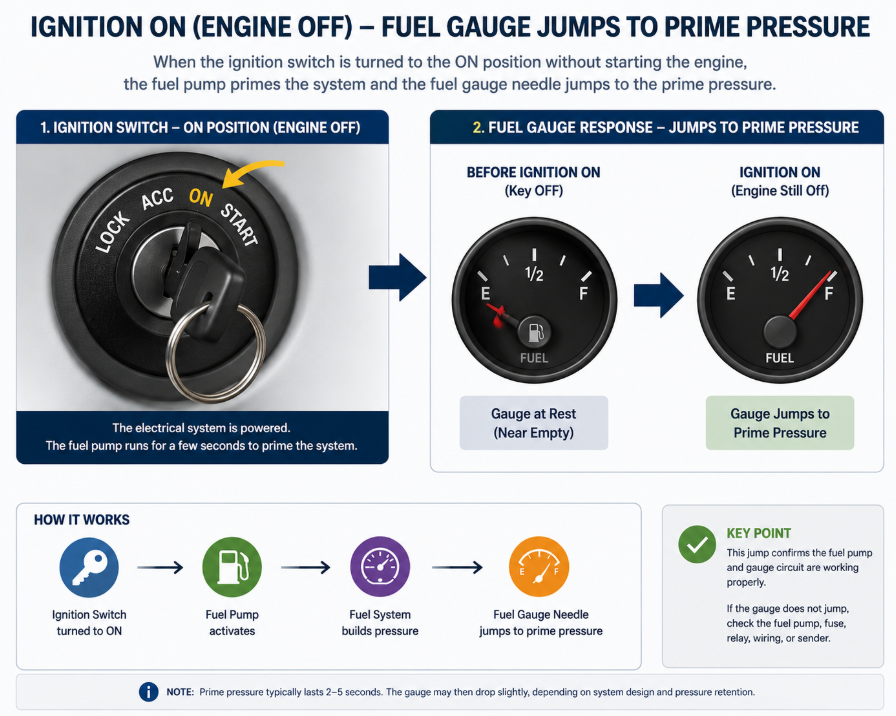
Step 2: Power On Without Ignition (KOEO)-Pre-Built Pressure Test
This test is mainly to see if the fuel pump can hit the initial starting pressure when the engine is not turning.ngine running.
- Start with ignition to warm up the engine and enter a stable idle state.
- Keep an eye on the needle reading and see if the pointer shakes or jumps violently.
- Find the vacuum tube on the fuel pressure regulator (provided that your car has an oil return system and a vacuum regulator is installed on the rail).
- Unplug this vacuum tube and keep your eyes on the pressure gauge at the same time. The moment it is unplugged, the pressure should immediately go up 5 to 10 PSI. If the pressure does not move, or if you see the newly unplugged vacuum interface ticking and leaking gasoline, then the diaphragm inside the regulator has broken and must be replaced immediately.
Step 4: 10-Minute Fuel Pressure Holding (Leakage) Test
Many cars are difficult to light after stopping for a while, often because the pressure cannot be kept after stalling.
- After finishing the car test, turn off the engine.
- Don’t pull out the pressure gauge, then count down 10 minutes with your mobile phone.
- Stare at the dial. The normal fuel system can keep the pressure, and the pressure drop will not exceed 2 to 5 PSI within 10 minutes. If you watch the watch needle fall all the way to zero, there must be a leak in the system, which needs further investigation.
How to understand the fuel pressure gauge: crack the secret behind the data
Only by reading these data can you avoid headache and foot treatment and spend money on useless accessories.
| Diagnostic Test | Observed Pressure Reading | Potential System Fault | Required Action |
|---|---|---|---|
| KOEO / KOER | Within OEM factory specs | None (Fuel delivery is healthy) | Look for ignition or sensor issues. |
| KOEO / KOER | Consistently below specs | Clogged filter, weak pump, or restricted feed line | Check voltage at pump; replace fuel filter. |
| KOEO / KOER | Significantly above specs | Stuck regulator or blocked fuel return line | Inspect return line for kinks; replace regulator. |
| Leak-Down | Drops to zero immediately | Faulty check valve, leaking regulator, or dripping injectors | Perform the Triple-Isolation Pinch Tes |
Old Mage’s Disorder Special: 3 Step Pinch Tube Isolation Test Method
If the car doesn’t pass the 10-minute pressure hold test just now, don’t guess to find the leak. As long as your car is equipped with an oil return system, prepare two flexible pipe clamps that will not hurt the pipe. Use the following set of “3-step pipe clamping method” to find out the internal leak in a few minutes.
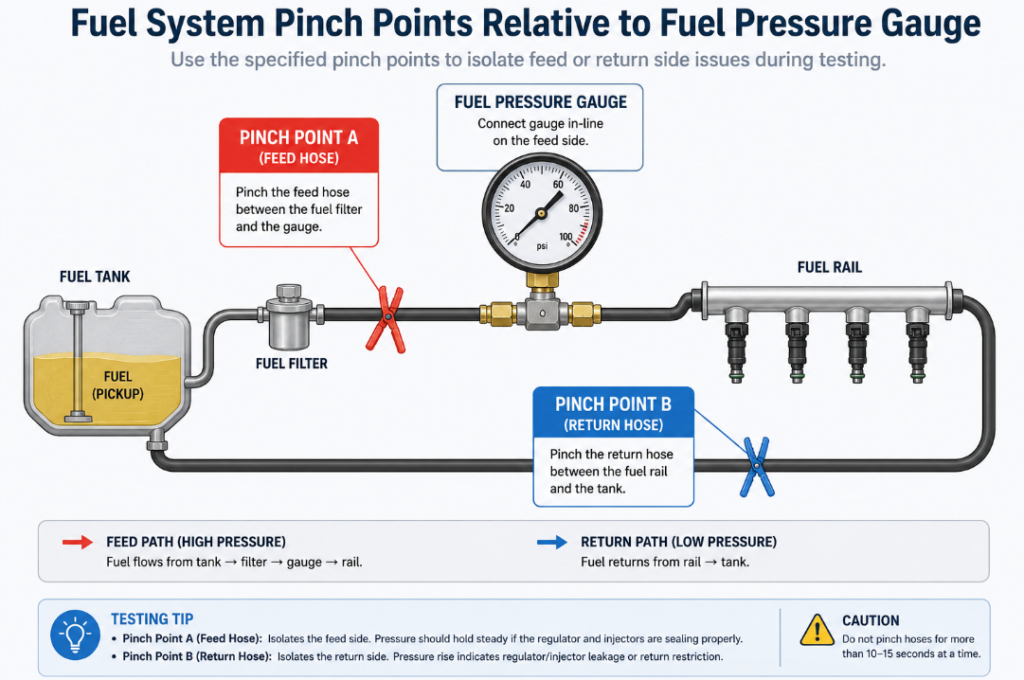
Step 1: Check The Fuel Pump Check Valve
Power up the highest pre-pressure and then turn off the key. With quick eyes and hands, immediately use pliers to clamp the rubber oil inlet pipe between the pressure gauge and the oil tank (let’s call it pinch point A).
Results Analysis: If the pressure miraculously stabilise at this time and does not fall again, it means that the leak is behind the pliers. That is, the one-way valve in the fuel pump assembly is broken and the pump must be replaced.
Result analysis: If the pressure is still falling, the leak point is further ahead of the engine compartment. Let’s continue with the second step.
Step 2: Check The Fuel Pressure Regulator
Re-energize the voltage and turn off the key. Clamp the rubber return line behind the fuel pressure regulator immediately (pinch point B).
Result analysis: If the pressure does not drop, it means that the spring inside the fuel pressure regulator is soft or stuck in the open state. A new regulator can solve it.
Result analysis: If the oil inlet pipe and the oil return pipe are clamped, and the pressure still falls down, the leakage point must be between the two clamps. Proceed to the third step.
Step 3: Grab The Dripping Nozzle
The first and last two pipes were strangled and the pressure fell. There is only one truth: there must be one or more injectors stuck and not closed, and they are ticking to leak gasoline into the combustion chamber. You can remove the spark plug to see if the electrode head is wet with gasoline bubbles; or directly bring the fuel injector to the end of the entire fuel rail, and observe which nozzle is dripping oil under pressure.tially open and dripping raw fuel directly into the combustion chambers. Remove the spark plugs to inspect for wet, fuel-soaked tips, or pull the fuel rail up with the injectors attached to observe which nozzle is dripping fuel under pressure.
Several pits to avoid when measuring oil pressure by yourself
Even veterans often roll over in the following places, ranging from inaccurate readings to damaged parts.
- I forgot to relieve the pressure before disassembling the watch: the pipe is full of oil, you can screw the joint directly, and the gasoline will definitely spray you and the engine. Always remember: Before unscrewing the connector, you must first press the pressure relief valve on the pressure gauge to drain the gasoline into a special container.
- Ignore the random jump of the pointer: If the watch needle keeps flashing like a convulsive when the engine is running, it means that air has entered the system or there is mechanical obstruction. It is usually because the filter in the fuel tank is severely blocked, or the fuel pump motor itself is about to break.
- I think the same is done for the non-oil return system: the non-oil return system (very common in cars after 2005) has directly placed the regulator in the oil tank. This kind of car can’t find the return pipe in the engine compartment, so you can’t use the “pinch pipe test” mentioned above “. To measure the internal leakage of this kind of car, a special series shut-off valve (shut-off adapters) is used to isolate it.
FAQs
Q1: When the engine is idling, what should the fuel pressure be considered normal?
Idle pressure (KOER) depends entirely on how the engine is designed. However, when most multi-point EFI engines are idling, the pressure is between 35 and 50 PSI. Before you start, you must look through the maintenance manual of your car to check the specific standard range. You must know that the pressure of the old-fashioned single-point (throttle body) EFI system may be as low as 10 to 15 PSI, while the modern cylinder The direct injection system, even the low-pressure fuel supply pump part, has a much higher operating pressure.
Q2: Why do I 1 turn off the car key and the fuel pressure drops to zero in an instant?
One second to zero is definitely there is a serious internal leak. The most common situation is: the one-way valve in the fuel pump is broken, the diaphragm of the fuel pressure regulator is broken, or the fuel injector is stuck in a normally open state. Before placing an order to buy accessories, use the “3 step pinch tube isolation test method” taught in the article to find out the exact culprit.
Q3: Will the broken gasoline filter element cause the oil pressure to be too low?
Absolutely will! If the gasoline filter element is severely blocked or clogged, the fuel cannot flow at all, and the working pressure on the gauge will naturally be low. Especially when you slam on the accelerator and the engine’s fuel demand increases greatly, the pressure drop is the most obvious. If the pressure of your car is normal when idling, 1 step on the accelerator and the pressure drops sharply. Don’t hesitate to change the gasoline filter first.
Q4: If there is no Schrader valve on my engine, how can I measure the oil pressure?
Then you have to find a tee from the test kit to connect in series. Pull out the main fuel supply hose into the fuel rail, string the three-way connector in the middle, and then connect the test gauge to the remaining connector of the three-way.
Q5: Can I just find a cheap oil pressure gauge to measure the fuel pressure?
Absolutely not! Never use an oil gauge as a fuel gauge. The hose and internal sealing ring in the special fuel pressure gauge are made of special materials, which can resist highly corrosive gasoline and solvents. If an ordinary oil gauge touches gasoline, the sealing ring inside will soon be destroyed, resulting in a catastrophic gasoline leak.
Q6: If the pointer of the pressure gauge trembles violently, what does this mean?
The pointer vibrates wildly, which generally indicates that air is sucked into the system, or the mechanical gear inside the fuel pump is seriously damaged, resulting in extremely unstable oil pulse. It is suggested to check whether the oil inlet filter at the front end of the oil pump is blocked, or to see if the oil in the oil tank is almost bottoming out.