 Dypressuregauge
Master CDL Supply & Application Air Pressure Gauges
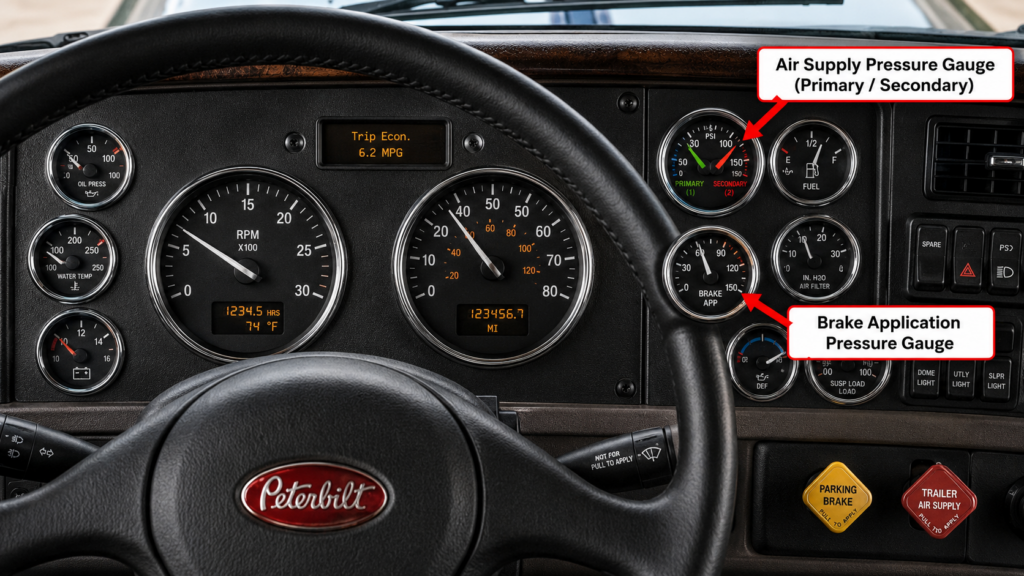
Air pressure gauges on heavy commercial trucks (whether mechanical dials or digital meters) are designed to measure the compressed air pressure (in PSI) of the drive brake system. The “Supply pressure gauge” (Supply gauge) can accurately display how much spare air is left in the main and auxiliary air tanks; while the “brake pressure gauge” (Application pressure gauge) reflects when you step on the brake pedal When, the actual air pressure delivered to the brake air chamber.
To successfully pass the CDL (commercial driver’s license) pre-line inspection, rote memorization of these definitions is a basic skill. But if you want to drive a 80000-pound heavy truck safely on a long downhill section with a 6% slope, you must have a deep understanding of how the two meters are linked while driving. Some drivers just stare at the road while driving, completely ignoring the mathematical relationship between air storage and brake air pressure, which often leads to catastrophic brake failure.
What Exactly Is A Barometer On A Heavy Truck
Simply put, the barometer is to convert the pneumatic force into a number that the driver can understand. Heavy commercial vehicles have completely abandoned hydraulic oil in favor of compressed air, because the air will never boil at extremely high temperatures and can be continuously replenished by on-board air compressors. On a standard Class 8 heavy truck dashboard, you’ll usually see dual-pointer or dual-screen digital meters that display the health of the pneumatic cycle system in real time.
What Is The Use Of Gas Storage Pressure Gauge
From the perspective of laws and regulations and physics, the gas storage pressure gauge determines whether you can drive this truck or not. It is responsible for monitoring the compressed air reserve in the main air tank (responsible for rear wheel braking) and the auxiliary air tank (responsible for front wheel braking).
Pressure regulating valve circulation and safe working range
During normal driving, a gas pocket meter pointer in good condition will always float back and forth between 100 psi and 125 psi. When the pressure drops to 100 psi, the pressure regulating valve of the air compressor will “cut in” (cut in) and start working to re-establish the air pressure reserve. When the air pressure reaches the upper limit of 120-125 psi, the pressure regulator will “cut out” (cut out), and you can hear the air dryer make a signature exhaust sound (similar to the sound of a sneeze). If you cannot raise the gas storage meter to 100 psi within 45 seconds during the CDL pre-line inspection, this means that the air compressor is about to be scrapped and the truck must be shut down immediately.
60 PSI “DEATH HAZARD” WITH SPRING BRAKE
The air pressure in the air tank has actually been competing with the powerful mechanical spring in the brake air chamber. You need at least 60 psi of reservoir pressure to hold the heavy emergency spring brake to death. If a system leak causes the reservoir gauge to drop below 60 psi, the low air pressure alarm buzzer will sound shrill. If the pointer continues to fall to between 20 and 45 psi, the trailer protection valve will pop out with a “bang” and the spring brake will automatically lock instantly. At this time, your truck will slip out of control in the middle of the highway, forcing it to stop violently.
What Does The Brake Pressure Gauge Show?
The brake pressure gauge is like a mirror of your right foot. It can accurately show how much air pressure (PSI) is passing through the foot valve and finally acting on the brake drum.
Measuring braking efficiency
When you step on the brake pedal of a heavy truck, you are not pushing the brake pads by the strength of your body, but opening an air valve. Usually lightly step on the brakes to slow down normally, only 10 to 15 psi brake pressure is enough. However, if it is a violent 1 foot emergency brake, the value on the brake gauge will instantly soar to 60 or even 70 psi. When taking the CDL road test, the examiner will stare at the watch to see if you are applying pressure smoothly and step by step. You must not be surprised and 1 suddenly step on the pedal to make the meter value soar.
Warning signal of brake heat attenuation
In the long downhill section, the brake pressure gauge is actually an early warning system for brake thermal attenuation. Once the brake drum overheats and expands, the brake pads must move a longer distance to rub against it. At this time, you will find that the original pedaling force of 15 psi cannot reduce the speed at all. In order to maintain the same speed, you have to pedal to 30 psi. The continuous “upward climb” of the value of this brake pressure gauge is ironclad evidence that the brakes are seriously decaying. At this time, don’t think about anything, and quickly drive the car into the escape lane for out-of-control vehicles.
“S-A-B” Air Brake Logic Model
Novice drivers panic when they hear the alarm, often because they see the data on the dashboard as isolated information. In fact, with S-A-B (store, apply, balance) framework, they can be connected in mechanical logic.
Storage (Store/air supply): Before starting in gear, you must first check whether the air storage meter is higher than 100 psi. Don’t move the car without gas.
Apply: Braking force is under your control. Staring at the brake pressure gauge and controlling the air pressure below 20 psi can ensure smooth and non-emergency deceleration.
Balance (Balance/relationship between the two): As long as the value of the brake meter rises 1, the gas storage meter will definitely fall down. If you step on a brake pressure of 20 psi, when you release the pedal, the 20 psi air will be discharged directly into the atmosphere and will never come back. You must learn to control the frequency and strength of the brakes, and set aside time for the air compressor to replenish air. This is called balance.
| Gauge | Normal Range | Warning Threshold | DOT Out-of-Service Limit | Action Required |
| Supply Pressure Gauge | 100 – 125 PSI | Drops below 60 PSI (Low-air buzzer activates) | Fails to reach 100 PSI within 45 seconds / Leak > 3 PSI/min | Verify reading is > 100 PSI before driving. Stop immediately if alarm sounds to allow compressor to rebuild. |
| Application Pressure Gauge | 10 – 20 PSI | Upward creep (e.g., needing 30+ PSI to maintain speed, indicating brake fade) | Inability for driver to display gauge on digital dash during Level 1 Inspection | Keep under 20 PSI for normal stops. Balance pedal applications (snubbing) to give compressor time to rebuild supply. |
Why Do Drivers Always Stumble In CDL And DOT Inspections
Team remote monitoring data show that drivers have been repeatedly deducted points or even fined in state examinations and road inspections, often because there are two fatal operational blind spots on the barometer.
The pitfalls of modern digital dashboards
In order to save screen space, the new Freightliner Cascadias and Volvo VNL have long since eliminated the mechanical pointer and replaced it with a highly integrated digital screen. Manufacturers often hide the brake pressure gauge under the three-tier menu. In the first level inspection of DOT (Department of Transportation), law enforcement officials often ask drivers to adjust the brake pressure value. Many drivers took a huge ticket because they didn’t know which keys on the steering wheel to press, checked and hung up the subject directly. Before leaving the station, remember to find out the menu operation path of your truck.
Air Pressure Exhaustion Trap Caused by “Point Brake”
Newcomers who have just got their driver’s license are particularly fond of “braking” (frequently stepping on and releasing the brakes) when going downhill, thinking that this will prevent overheating. They 1 their foot down (the brake table soars), release, and then step again. You know, every time you step on it, you will directly drain away a lot of precious air. When going downhill, the pressure of the gas storage meter can be squeezed from 120 psi to 60 psi in less than one minute. Then the low air pressure alarm sounded, the spring brake locked, and the driver completely lost control on the downhill road. The correct approach is to use the “containment method” (snubbing): smoothly apply 15-20 psi of brake pressure, reduce the vehicle speed by 5 mph, and then fully release the pedal to allow the brake drum to dissipate heat, while allowing the air storage meter to recover Time for air pressure.
Case Study: Real Monitoring Data Of 7% Long Downhill
In a fleet safety audit in 2023, the background tracked the air pressure system data of the 1 80000-pound tractor truck as it descends the Donner Pass (7% slope).
Driver A (wrong operation): all the way to die on the brake pedal, has been maintaining a brake pressure of 12 psi. As a result, after only three miles, the brake drum temperature soared to 600 °F (315°C). Because of severe thermal expansion (brake heat decay), Driver A finally had to press the brake pressure to 45 psi to barely stop the car.
Driver B (Containment Method): Actively use engine braking and cooperate with three decisive brake actions, each time applying 20 psi pressure for 3 seconds. Throughout the descent, the brake drum temperature never exceeded 300 °F (150°C), and the air reservoir gauge never dropped below 105 psi. Driver B steadily maintained control of the pneumatic system throughout the process.
Frequently Asked Questions (FAQs)
What is the normal working pressure of the truck air brake system?
The normal operating range of the reservoir pressure gauge is between 100 psi and 125 psi. The air compressor will automatically cycle in this interval to ensure that you have the maximum braking power at any time.
When the air pressure drops to how much will the low air pressure alarm be on?
When the air storage pressure gauge drops below 60 psi (half of the cut-out pressure of the pressure regulating valve in the old system), the low air pressure indicator and buzzer will automatically start.
What happens when the brake pressure is too high?
If you directly 1 your foot to step on a brake pressure of 60 to 90 psi without ABS (anti-lock braking system), the truck wheels will lock instantly. This can cause the tires to slip, which can easily lead to fatal trailer folding (jackknife) or complete loss of steering control.
Why does my gas storage meter fall off after being put on overnight?
Air brake system used for a long time, will naturally produce extremely small leakage. According to the CDL standard, the air leakage of the parked truck shall not exceed 3 psi per minute when the brake is applied, and shall not exceed 2 psi per minute when the brake is released. If the air pressure is completely leaked overnight, it usually indicates that the sealing ring of the handshake valve (gladhand) connecting the trailer is worn out, or the relay valve is malfunctioning.
how to test the brake pressure gauge?
First let the system air pressure to 120 psi, then shut down the engine. Turn the key to the “ON” position (energized but not ignited). Press the brake pedal firmly and hold it steady. At this time, the brake pressure gauge will rise and accurately display the psi value you are currently stepping on.
Which table can see how much air there is in the tank?
The gas storage pressure gauge (usually marked with Primary main gas tank and Secondary auxiliary gas tank on the dial) can tell you the exact amount of compressed air reserve in the gas storage tank.