 Dypressuregauge
What Liquid Is In A Pressure Gauge? Glycerin vs Silicone
The liquid inside a pressure gauge is typically glycerin, silicone oil, or in specialized cases, halocarbon. Glycerin is the industry standard for dampening heavy vibration at room temperature, while silicone handles extreme thermal fluctuations without freezing or degrading. Picking the wrong fluid does more than just break the gauge—it can trigger a chemical explosion or shut down your entire production line. Let’s break down exactly what liquid you need for your specific industrial application.
Direct Answer: What Liquid Is In A Pressure Gauge?
Liquid-filled pressure gauges rely on viscous fluids to protect the delicate Bourdon tube from pressure spikes, pulsation, and mechanical vibration.
Glycerin remains the most common fill fluid. Engineers specify glycerin for roughly 80% of standard industrial applications because it offers excellent vibration dampening at a low price point. Silicone oil steps in when conditions get tough. You will find silicone in outdoor applications facing freezing winters or blistering summers. Halocarbon acts as the strict requirement for systems involving oxidizing agents like pure oxygen or chlorine.
“ShiPing ChaRu” (Prompt for you: Insert a 15-second side-by-side video showing a dry gauge needle bouncing violently vs. a liquid-filled gauge needle remaining perfectly steady under pulsating pressure.)
The T.E.M. Protocol: A 3-Step Selection Framework
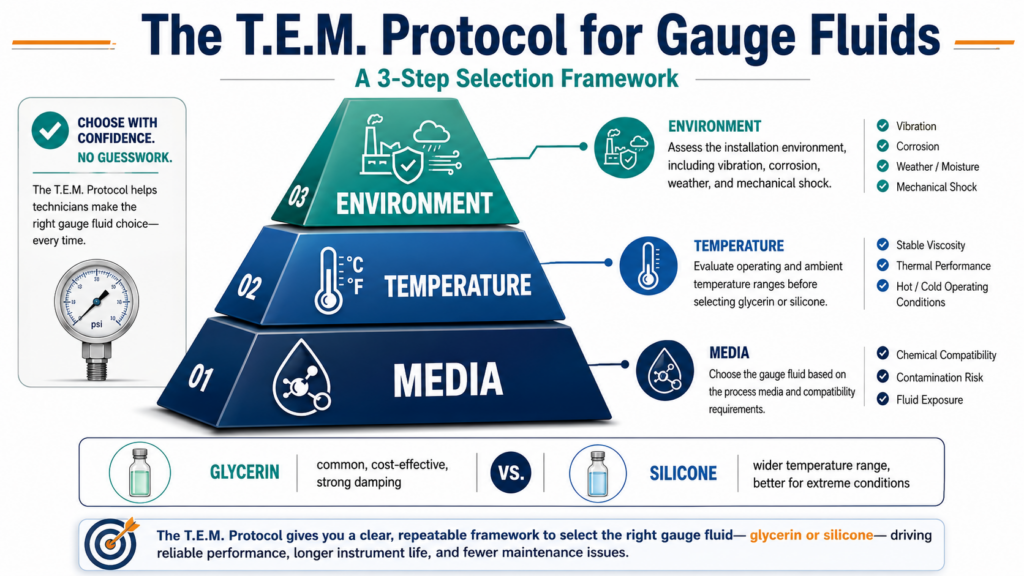
Factory technicians often guess when re-ordering equipment. The T.E.M. Protocol (Temperature, Environment, Media) removes the guesswork from choosing between glycerin and silicone.
Temperature: The Viscosity Trap
Ambient temperature dictates fluid performance immediately. Glycerin thickens dramatically below 68°F (20°C) and completely crystallizes at 32°F (0°C). A frozen glycerin gauge will display a false zero or lock the needle at a high pressure reading, creating a massive safety hazard. Silicone oil maintains a stable viscosity index from -40°F up to 140°F (-40°C to 60°C). Choose silicone for any outdoor installation in cold climates.
Environment: The Paint Shop Dilemma
External facility conditions dictate strict material bans. Automotive paint shops and semiconductor cleanrooms strictly prohibit silicone. Even a micro-leak of silicone oil from a damaged pressure gauge will cause “fish-eyes”—severe adhesion failures—in automotive clear coats. Glycerin is water-soluble, easily washable, and poses zero threat to surface adhesion processes. Use glycerin strictly in painting, coating, and electronics manufacturing zones.
Media: The Hidden Explosion Risk
The fluid inside the pipe interacting with a ruptured gauge tube dictates life-or-death safety protocols. Glycerin is a hydrocarbon-based organic compound. Exposing glycerin to strong oxidizing agents like compressed oxygen, chlorine, or hydrogen peroxide creates an immediate, violent exothermic reaction. An internal explosion will shatter the dial glass outward at high velocity. Halocarbon (an inert fluid) is the mandatory legal and safety requirement for oxygen service gauges.
Glycerin Vs. Silicone: Engineering Data Breakdown
Raw performance specs reveal exactly where each fluid belongs on the factory floor.
| Metric | Glycerin | Silicone Oil |
| Temp Range | > 32°F (0°C). Thickens below 68°F (20°C) and freezes at 32°F (0°C). | -40°F to 140°F (-40°C to 60°C). Maintains a stable viscosity index. |
| Viscosity | High (Typically 1,000 cSt at room temperature). Excellent for heavy shocks. | Low to Medium (Typically 50 to 500 cSt). Thinner consistency. |
| Water Solubility | Yes (Water-soluble and easily washable). | No (Non-aqueous). Can cause severe adhesion failures (“fish-eyes”). |
| Price Tier | Low (Industry standard, highly economical). | Moderate (Premium upgrade, typically ~$10 more per gauge). |
| Best Application | Paint shops, coating zones, electronics manufacturing, and heavy hydraulic presses at room temp. | Outdoor installations, cold climates, and environments with extreme thermal fluctuations. |
Glycerin delivers higher absolute viscosity (typically 1000 cSt at room temp) compared to standard silicone (which ranges from 50 to 500 cSt). This means glycerin physically absorbs violent mechanical shocks from heavy hydraulic presses better than thinner silicone. Silicone, being synthetic and non-aqueous, never supports bacterial growth or degrades under harsh UV sunlight, ensuring the dial face remains readable for decades.
Field Case Study: Why A $20 Gauge Caused A $15,000 Shutdown
In January 2023, an industrial pump station in Fairbanks, Alaska experienced a catastrophic failure. The procurement team had bulk-ordered standard glycerin-filled gauges for external pipelines.
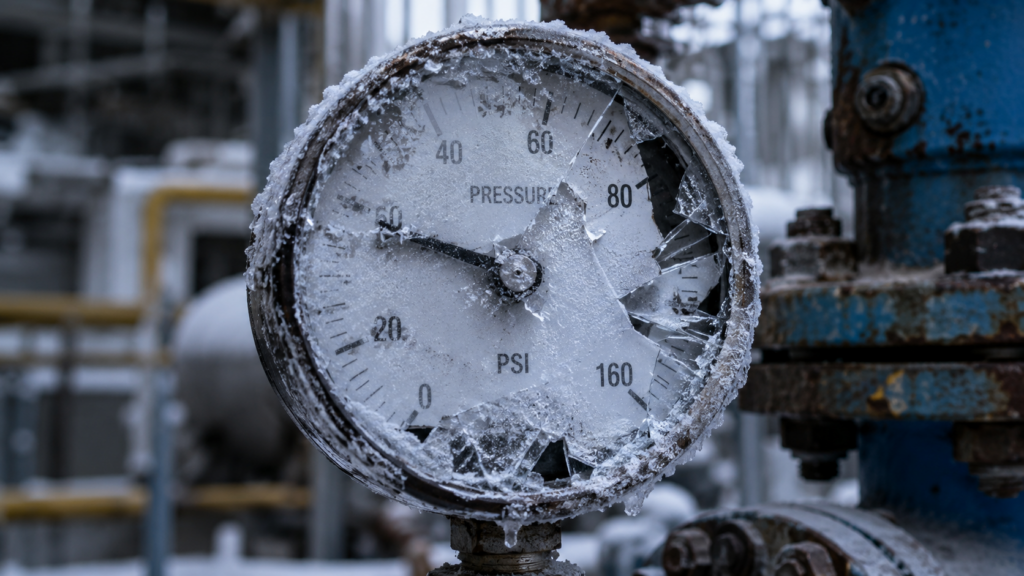
The ambient temperature dropped to -15°F (-26°C). The glycerin inside the gauges crystallized solidly, locking the indicator needles at 45 PSI. The actual pipeline pressure spiked to 120 PSI, but operators trusted the frozen gauges. The resulting overpressure blew out two primary seals on a centrifugal pump, causing a localized spill and a 12-hour plant shutdown. The facility lost $15,000 in downtime. Upgrading to silicone-filled gauges (a mere $10 price difference per unit) would have entirely prevented the failure.
People Also Ask (PAA)
Why do pressure gauges have liquid in them?
Liquid fills the gauge casing to absorb continuous vibration, dampen pressure spikes, and lubricate the internal mechanical gears. This greatly extends the lifespan of the equipment and keeps the needle steady for accurate readings.
Can you refill a liquid-filled pressure gauge?
Yes. Most industrial liquid-filled gauges feature a rubber fill plug at the top. You can vent the gauge, pull the plug, and refill the fluid to the 80% mark, ensuring an air bubble remains at the top for temperature expansion.
What happens if a pressure gauge leaks liquid?
A slow leak reduces the dampening effect, causing the needle to bounce. The gauge will still measure pressure accurately via the Bourdon tube, but the internal gears will wear out rapidly without the fluid’s lubrication.
Is the liquid in a pressure gauge toxic?
No. Pure glycerin is completely non-toxic and often used in the food and beverage industry. Standard silicone oil is also non-toxic, though it can create a severe slipping hazard if spilled on a concrete factory floor.
Can I use water in a pressure gauge?
No. Water lacks the viscosity needed to dampen mechanical vibration. Water also corrodes internal brass components, promotes algae growth in the dial, and expands when frozen, which will permanently shatter the gauge casing.
How do I know if my gauge has glycerin or silicone?
Glycerin is noticeably thicker and feels sticky to the touch. Silicone oil feels exceptionally slick and rubs easily between the fingers without stickiness. Checking the manufacturer’s part number on the dial face remains the safest verification method.
What is halocarbon used for in gauges?
Halocarbon serves as an inert fill fluid specifically for systems handling highly reactive chemicals. Engineers mandate halocarbon for oxygen, chlorine, and nitric acid lines because it will not combust or react if the internal tube bursts.